Question 9
Ten moles of an ideal monoatomic gas, initially in state at atmospheric pressure and temperature , is enclosed in a metal cylinder of volume fitted with a frictionless piston. The gas is suddenly compressed to state with volume . Now, keeping the piston stationary, the cylinder is submerged in a water bath of temperature until the gas reaches the temperature of the water bath, which is denoted as state . Finally, while still in the water bath, the piston is brought slowly to its initial position, which is denoted as state . If is universal gas constant, then the correct option(s) is/are:
[Given: ]
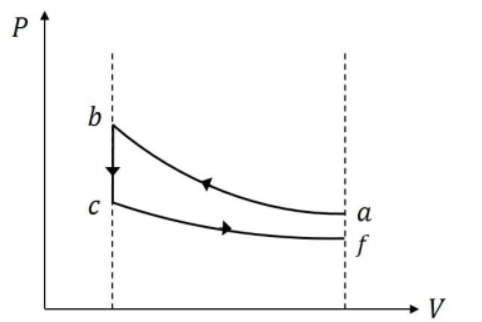
The schematic P-V diagram of the processes described above is:
The change in internal energy in going from state to is .
The net change in the internal energy in the whole process is .
The pressure and temperature of the state are times the atmospheric pressure and , respectively.
Detailed Solution
1. Process (Sudden Compression): This is an adiabatic process. Given: , , , . For a monoatomic gas, and . Temperature at : Given , so . Pressure at : . Since the pressure is times the atmospheric pressure (not ), Option (D) is incorrect.
Change in internal energy: . Option (B) is correct.
2. Process (Isochoric Cooling): The piston is kept stationary, so the volume is constant at . The temperature reaches the bath temperature, .
3. Process (Isothermal Expansion): The piston is brought slowly to its initial volume while submerged in the water bath. Therefore, the temperature remains constant at until the volume reaches .
4. Net Internal Energy Change: The net change in internal energy depends only on the initial and final states of the entire process. . Option (C) is correct.
5. P-V Diagram Analysis:
- : Adiabatic compression (steep curve to the left, volume decreases).
- : Isochoric cooling (vertical line downwards, pressure drops at constant volume).
- : Isothermal expansion (flatter curve to the right, ending at ). Additionally, at the final state , but . Thus, . The schematic correctly shows point lying below point on the same vertical volume line. Option (A) is correct.
**Correct Options: (A), (B), (C)**1. Process (Sudden Compression): This is an adiabatic process. Given: , , , . For a monoatomic gas, and . Temperature at : Given , so . Pressure at : . Since the pressure is times the atmospheric pressure (not ), Option (D) is incorrect.
Change in internal energy: . Option (B) is correct.
2. Process (Isochoric Cooling): The piston is kept stationary, so the volume is constant at . The temperature reaches the bath temperature, .
3. Process (Isothermal Expansion): The piston is brought slowly to its initial volume while submerged in the water bath. Therefore, the temperature remains constant at until the volume reaches .
4. Net Internal Energy Change: The net change in internal energy depends only on the initial and final states of the entire process. . Option (C) is correct.
5. P-V Diagram Analysis:
- : Adiabatic compression (steep curve to the left, volume decreases).
- : Isochoric cooling (vertical line downwards, pressure drops at constant volume).
- : Isothermal expansion (flatter curve to the right, ending at ). Additionally, at the final state , but . Thus, . The schematic correctly shows point lying below point on the same vertical volume line. Option (A) is correct.
Correct Options: (A), (B), (C)
Boost Your Exam Preparation!
Move beyond just reading solutions. Access our comprehensive Test Series, original Mock Tests, and interactive learning modules. Many premium tests are completely free!
- Original Mocks & Regular Test Series
- Real NTA-like Interface with Analytics
- Many Free Tests Available