Question 5
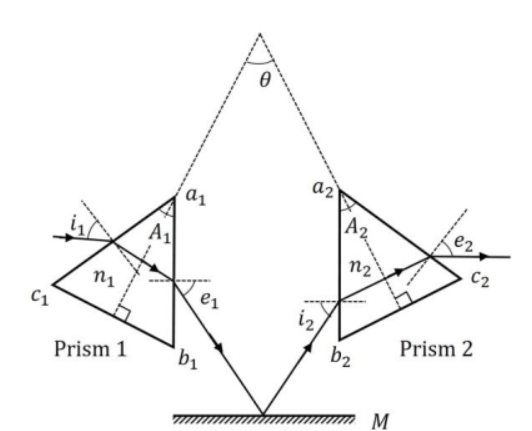
Consider two isosceles prisms 1 and 2 with prism angles and and refractive indices and , respectively, as shown in the figure. The faces and are parallel to each other and perpendicular to the mirror . If a ray of light is incident on the face and emerges from the face , then the correct statement(s) is/are:
If both the prisms are at minimum deviation condition, then .
If prism 2 is at minimum deviation condition, then is always true.
If both the prisms 1 and 2 are thin and are at minimum deviation condition with angles of deviation and , respectively, then .
If prism 1 is at minimum deviation condition, then is always true.
Detailed Solution
Core Geometrical Constraint: Faces and are parallel to each other and perpendicular to the horizontal mirror . When a ray emerges from Prism 1 with an angle of emergence , it reflects off the mirror and strikes Prism 2. Due to the symmetry of reflection and parallel vertical faces, the angle of incidence on Prism 2 will always be equal to the angle of emergence from Prism 1: (This is always true).
1. Checking Option (D): If Prism 1 is at minimum deviation, then and by Snell's law, . Since (from our core constraint), we can substitute to get: . Therefore, Option (D) is always true.
2. Checking Option (B): If Prism 2 is at minimum deviation, then and . Since , we can write . However, because Prism 1 is not necessarily at minimum deviation, . Thus, is NOT always true. Option (B) is incorrect.
3. Checking Option (A): If both prisms are at minimum deviation: For Prism 1: and For Prism 2: and Since , we can equate the two expressions: Therefore, Option (A) is correct.
4. Checking Option (C): For thin prisms at minimum deviation, the deviation angle is . This gives and . From the geometry of the dashed lines (altitudes/bisectors of the isosceles triangles), the angle between the prisms is: Substituting the values of and : Therefore, Option (C) is correct.
Correct Options: (A), (C), (D)
Boost Your Exam Preparation!
Move beyond just reading solutions. Access our comprehensive Test Series, original Mock Tests, and interactive learning modules. Many premium tests are completely free!
- Original Mocks & Regular Test Series
- Real NTA-like Interface with Analytics
- Many Free Tests Available