Question 18
Rotational Dynamics of a Pivoted Circular Disk and Particle Collision
A uniform circular disk of radius and mass is pivoted at its top point such that it can rotate freely around in the plane, as shown in the figure. Initially, when the disk is at rest, a particle of mass , travelling along negative direction in the plane with speed , hits the circumference of the disk at a point . After collision the particle moves along negative direction at a speed of . [Given: the acceleration due to gravity ]
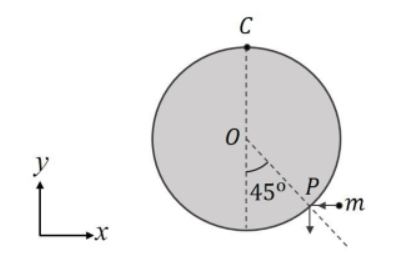
Amount of energy loss (in J) in the collision is:
Detailed Solution
-
Initial Kinetic Energy: .
-
Final Kinetic Energy: . (from previous question calculation) . Total .
-
Energy Loss: Loss . Rounding to one decimal place, we get .
Boost Your Exam Preparation!
Move beyond just reading solutions. Access our comprehensive Test Series, original Mock Tests, and interactive learning modules. Many premium tests are completely free!
- Original Mocks & Regular Test Series
- Real NTA-like Interface with Analytics
- Many Free Tests Available