Question 17

NUMERICALHARD

Rotational Dynamics of a Pivoted Circular Disk and Particle Collision

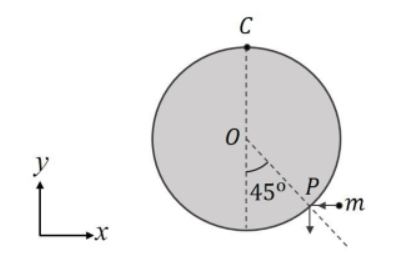
A uniform circular disk of radius 0.2Β m0.2 \text{ m} and mass 1Β kg1 \text{ kg} is pivoted at its top point CC such that it can rotate freely around CC in the XYXY plane, as shown in the figure. Initially, when the disk is at rest, a particle of mass 20Β g20 \text{ g}, travelling along negative xx direction in the XYXY plane with speed 100Β msβˆ’1100 \text{ ms}^{-1}, hits the circumference of the disk at a point PP. After collision the particle moves along negative yy direction at a speed of 90Β msβˆ’190 \text{ ms}^{-1}. [Given: the acceleration due to gravity (g)=βˆ’10j^Β msβˆ’2(g) = - 10 \hat{j} \text{ ms}^{-2}]

Passage

After the collision the disk starts to rotate around point CC in the XYXY plane. The maximum change in the height (in m) of its center OO is:

Correct Answer: 0.15

Detailed Solution

  1. Angular Momentum Conservation about pivot CC: Initially, Lβƒ—i=rβƒ—P/CΓ—mvβƒ—1\vec{L}_i = \vec{r}_{P/C} \times m\vec{v}_1. Given PP is at 45∘45^\circ below the horizontal relative to center OO, the coordinates relative to CC are (Rcos⁑45∘,βˆ’(R+Rsin⁑45∘))(R \cos 45^\circ, -(R + R \sin 45^\circ)). Lβƒ—i=[Rcos⁑45∘i^βˆ’R(1+sin⁑45∘)j^]Γ—[βˆ’mv1i^]=βˆ’mv1R(1+sin⁑45∘)k^\vec{L}_i = [R \cos 45^\circ \hat{i} - R(1 + \sin 45^\circ) \hat{j}] \times [-mv_1 \hat{i}] = -mv_1 R(1 + \sin 45^\circ) \hat{k}. Magnitude Li=0.02Γ—100Γ—0.2(1+0.707)=0.6828Β kgΒ m2sβˆ’1L_i = 0.02 \times 100 \times 0.2(1 + 0.707) = 0.6828 \text{ kg m}^2\text{s}^{-1}.

Final particle angular momentum: Lβƒ—f,p=[Rcos⁑45∘i^βˆ’R(1+sin⁑45∘)j^]Γ—[βˆ’mv2j^]=βˆ’mv2Rcos⁑45∘k^\vec{L}_{f,p} = [R \cos 45^\circ \hat{i} - R(1 + \sin 45^\circ) \hat{j}] \times [-mv_2 \hat{j}] = -mv_2 R \cos 45^\circ \hat{k}. Magnitude Lf,p=0.02Γ—90Γ—0.2Γ—0.707=0.2545Β kgΒ m2sβˆ’1L_{f,p} = 0.02 \times 90 \times 0.2 \times 0.707 = 0.2545 \text{ kg m}^2\text{s}^{-1}.

Angular momentum of disk Ld=Liβˆ’Lf,p=0.6828βˆ’0.2545=0.4283Β kgΒ m2sβˆ’1L_d = L_i - L_{f,p} = 0.6828 - 0.2545 = 0.4283 \text{ kg m}^2\text{s}^{-1}.

  1. Angular Velocity calculation: IC=Icm+MR2=12MR2+MR2=32MR2=1.5Γ—1Γ—(0.2)2=0.06Β kgΒ m2I_C = I_{cm} + MR^2 = \frac{1}{2}MR^2 + MR^2 = \frac{3}{2}MR^2 = 1.5 \times 1 \times (0.2)^2 = 0.06 \text{ kg m}^2. Ο‰=LdIC=0.42830.06β‰ˆ7.138Β rad/s\omega = \frac{L_d}{I_C} = \frac{0.4283}{0.06} \approx 7.138 \text{ rad/s}.

  2. Height Change of Center OO: From energy conservation, 12ICΟ‰2=MgΞ”h\frac{1}{2} I_C \omega^2 = Mg \Delta h. Ξ”h=0.5Γ—0.06Γ—(7.138)21Γ—10=1.52810β‰ˆ0.153Β m\Delta h = \frac{0.5 \times 0.06 \times (7.138)^2}{1 \times 10} = \frac{1.528}{10} \approx 0.153 \text{ m}. Rounding to two decimal places, we get 0.15Β m0.15 \text{ m}.

Free Exam

Boost Your Exam Preparation!

Move beyond just reading solutions. Access our comprehensive Test Series, original Mock Tests, and interactive learning modules. Many premium tests are completely free!

  • Original Mocks & Regular Test Series
  • Real NTA-like Interface with Analytics
  • Many Free Tests Available