Question 15
Liquid Efflux and Variable Dielectric Capacitance
A container of height , length and breadth is made of insulating vertical walls and two large area horizontal metal plates ( and ) which extend far beyond the vertical walls in all directions. The container is partitioned into two equal chambers with a thin insulating vertical wall. The partition wall contains a small hole of cross-sectional area near its bottom edge. Initially the hole is closed and the left chamber of the container is completely filled with a liquid of dielectric constant and the right chamber is empty (). At time , the hole is opened and the liquid flows from the left chamber to the right chamber. In both the chambers, the space above the liquid has and is maintained at atmospheric pressure. The schematic of the container at a time is shown in the figure. [Given: acceleration due to gravity is ]
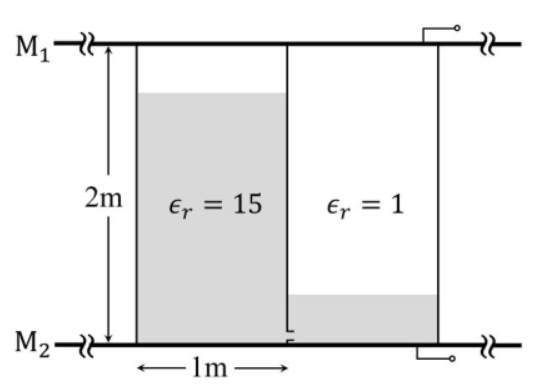
The height (in m) of the liquid in left chamber at is:
Detailed Solution
Let and be the heights of the liquid in the left and right chambers respectively.
The base area of each chamber is .
Since the total volume of liquid is conserved, , so .
The velocity of efflux through the hole of area is .
The rate of decrease of height in the left chamber is given by:
Substituting :
Separating variables and integrating from () to ():
Using and :
Boost Your Exam Preparation!
Move beyond just reading solutions. Access our comprehensive Test Series, original Mock Tests, and interactive learning modules. Many premium tests are completely free!
- Original Mocks & Regular Test Series
- Real NTA-like Interface with Analytics
- Many Free Tests Available