Question 6

MCQMEDIUM

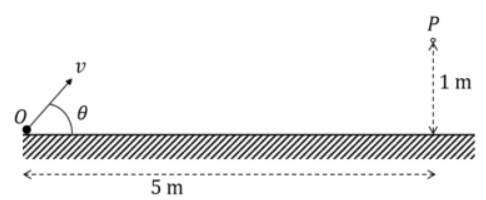
A particle is thrown with a speed vv from a point OO at an angle θ\theta with the horizontal plane such that it passes through the point PP at a height of 1 m and a horizontal distance of 5 m from OO, as shown in the figure. If acceleration due to gravity is gg ms2^{-2}, then the correct statement(s) is/are:
Question
(A)

If θ=45\theta = 45^\circ, then v=5g2v = \frac{5\sqrt{g}}{2} ms1^{-1}.

(B)

If θ=45\theta = 45^\circ, the particle reaches its maximum height before it reaches PP.

(C)

If θ=30\theta = 30^\circ, the particle reaches its maximum height after reaching PP.

(D)

If θ=tan1(15)\theta = \tan^{-1} \left( \frac{1}{5} \right), then v=125gv = 125\sqrt{g} ms1^{-1}.

Detailed Solution

The equation of trajectory for a projectile is given by: y=xtanθgx22v2cos2θy = x \tan \theta - \frac{gx^2}{2v^2 \cos^2 \theta}

Given the particle passes through P(5,1)P(5, 1), we substitute x=5x=5 and y=1y=1:

1=5tanθ25g2v2cos2θ1 = 5 \tan \theta - \frac{25g}{2v^2 \cos^2 \theta}

For option (A) and (B): θ=45\theta = 45^\circ.

1=5(1)25g2v2(1/2)2=525gv21 = 5(1) - \frac{25g}{2v^2 (1/\sqrt{2})^2} = 5 - \frac{25g}{v^2}

    25gv2=4    v2=25g4    v=5g2\implies \frac{25g}{v^2} = 4 \implies v^2 = \frac{25g}{4} \implies v = \frac{5\sqrt{g}}{2}. Thus (A) is correct.

The horizontal distance to maximum height is xh=R2=v2sin2θ2gx_h = \frac{R}{2} = \frac{v^2 \sin 2\theta}{2g}.

xh=(25g/4)sin902g=258=3.125x_h = \frac{(25g/4) \cdot \sin 90^\circ}{2g} = \frac{25}{8} = 3.125 m.

Since 3.125<53.125 < 5, the particle reaches maximum height before reaching PP. Thus (B) is correct.

For option (C): θ=30\theta = 30^\circ.

1=5tan3025g2v2cos230=5325g2v2(3/4)=53350g3v21 = 5 \tan 30^\circ - \frac{25g}{2v^2 \cos^2 30^\circ} = \frac{5}{\sqrt{3}} - \frac{25g}{2v^2 (3/4)} = \frac{5\sqrt{3}}{3} - \frac{50g}{3v^2}

50g3v2=5333    v2=50g53350g5.668.83g\frac{50g}{3v^2} = \frac{5\sqrt{3}-3}{3} \implies v^2 = \frac{50g}{5\sqrt{3}-3} \approx \frac{50g}{5.66} \approx 8.83g.

xh=v2sin602g=8.83g(3/2)2g3.82x_h = \frac{v^2 \sin 60^\circ}{2g} = \frac{8.83g \cdot (\sqrt{3}/2)}{2g} \approx 3.82 m.

Since 3.82<53.82 < 5, it reaches maximum height before reaching PP. Thus (C) is incorrect.

For option (D): If tanθ=1/5\tan \theta = 1/5, then xtanθ=5(1/5)=1x \tan \theta = 5(1/5) = 1.

The equation becomes 1=1gx22v2cos2θ1 = 1 - \frac{gx^2}{2v^2 \cos^2 \theta}, which implies gx22v2cos2θ=0\frac{gx^2}{2v^2 \cos^2 \theta} = 0. This requires vv \to \infty. Thus (D) is incorrect.

Free Exam

Boost Your Exam Preparation!

Move beyond just reading solutions. Access our comprehensive Test Series, original Mock Tests, and interactive learning modules. Many premium tests are completely free!

  • Original Mocks & Regular Test Series
  • Real NTA-like Interface with Analytics
  • Many Free Tests Available