Question 4
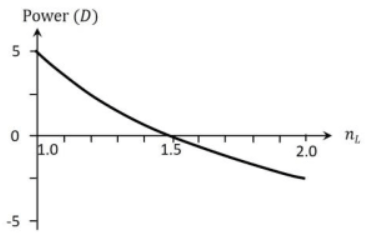
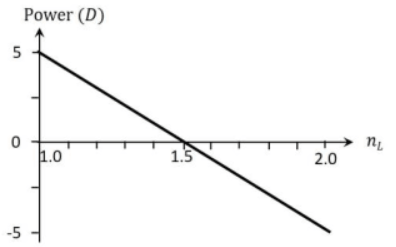
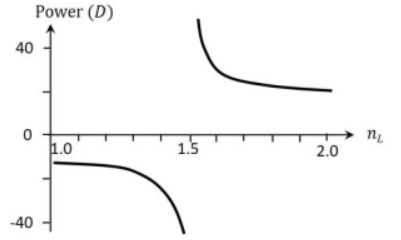
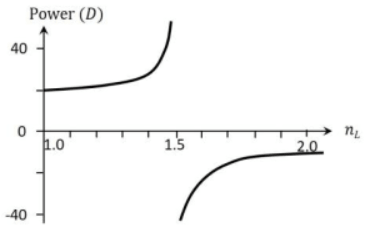
A double convex lens made of glass of refractive index and radii of curvature of the curved surfaces each is immersed in a liquid of refractive index . The correct plot showing the variation of the power, in the units of diopter (), as a function of is:
Detailed Solution
The power of a lens of refractive index immersed in a medium of refractive index is given by the sum of the powers of its two surfaces:
Given:
Refractive index of glass,
Radii of curvature for a double convex lens, and .
Substituting the values into the power formula:
This is a linear equation of the form , where the slope and the intercept .
Let's check specific points:
-
For :
-
For :
-
For :
The graph that represents this linear variation is shown in option (B).
Boost Your Exam Preparation!
Move beyond just reading solutions. Access our comprehensive Test Series, original Mock Tests, and interactive learning modules. Many premium tests are completely free!
- Original Mocks & Regular Test Series
- Real NTA-like Interface with Analytics
- Many Free Tests Available