Question 12
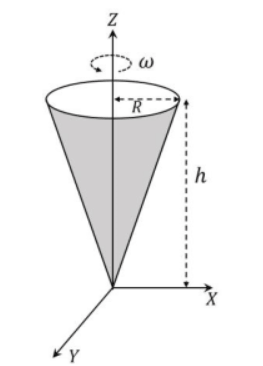
A hollow, right circular cone of base radius and height , with its tip at the origin is rotating about the Z-axis with an angular velocity , as shown in the figure. The cone carries a total charge uniformly distributed on its curved surface. The magnitude of magnetic field at a point , where and , is . The value of is:
Detailed Solution
-
Identify the system: We have a rotating hollow cone with surface charge . This system acts as a magnetic dipole for far-off points ().
-
Calculate the Magnetic Dipole Moment (): Consider an elemental ring on the curved surface at a distance along the slant height from the tip.
Let be the total slant height.
The radius of the ring is .
The charge on the ring element .
The magnetic moment of this rotating ring is .
Substituting and :
Integrating from to :
- Calculate Magnetic Field on Axis: For a dipole at a distance dimensions of the source, the magnetic field on the axis is given by:
Substituting the value of :
- Determine : Comparing with the given expression , we find .
Boost Your Exam Preparation!
Move beyond just reading solutions. Access our comprehensive Test Series, original Mock Tests, and interactive learning modules. Many premium tests are completely free!
- Original Mocks & Regular Test Series
- Real NTA-like Interface with Analytics
- Many Free Tests Available