Question 11
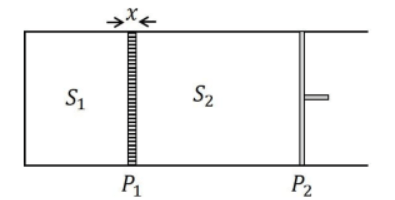
As shown in the figure, an insulated container is fitted with a thermally conducting but immovable partition () and a freely movable but thermally insulated piston (). The partition with thermal conductivity , cross sectional area and width divides the container into two sections, and , each containing one mole of a monoatomic gas. The piston moves freely such that the gas in is always at the atmospheric pressure. Initially, the difference between the temperatures of and is . The time it takes for the temperature difference to become is , where is the universal gas constant. The value of is: [ Given: ]
Detailed Solution
Let be the temperature in and be the temperature in .
Since the partition is immovable, section undergoes an isochoric process.
The heat gained by is .
Since the piston is freely movable, section undergoes an isobaric process. The heat lost by is .
The rate of heat transfer through the partition is:
Let . Then:
Substituting for :
Integrating from (where ) to (where ):
Comparing with , we get:
Boost Your Exam Preparation!
Move beyond just reading solutions. Access our comprehensive Test Series, original Mock Tests, and interactive learning modules. Many premium tests are completely free!
- Original Mocks & Regular Test Series
- Real NTA-like Interface with Analytics
- Many Free Tests Available