Question 1
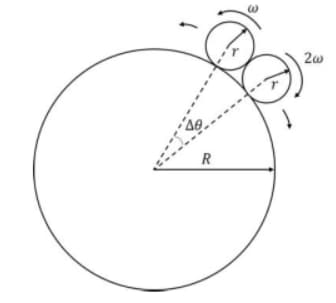
Consider a large disk of radius and two smaller disks, each of radius , lying on its circumference, as shown in the figure. The smaller disks are initially in contact with each other, with an angular separation between their centers. They are made to roll without slipping in opposite directions, with constant angular velocities and while the large disk is held stationary. The time at which the smaller disks are again in contact is: [Use and ignore gravity.]
Detailed Solution
Given , the distance from the center of the large disk to the center of each smaller disk is .
Initially, the disks are in contact, so the distance between their centers is . Using the approximation , the initial angular separation between the centers (subtended at the center of the large disk) is:
When a disk of radius rolls without slipping on a fixed surface, the velocity of its center is . The angular velocity of the center of disk 1 (with angular velocity ) about the center of the large disk is:
Similarly, for disk 2 (with angular velocity ):
Since they move in opposite directions, the relative angular velocity of their centers is:
For the disks to be in contact again on the opposite side, the relative angular distance to be covered by the centers is minus the initial and final angular gaps required for contact:
The time is:
Boost Your Exam Preparation!
Move beyond just reading solutions. Access our comprehensive Test Series, original Mock Tests, and interactive learning modules. Many premium tests are completely free!
- Original Mocks & Regular Test Series
- Real NTA-like Interface with Analytics
- Many Free Tests Available