Question 11
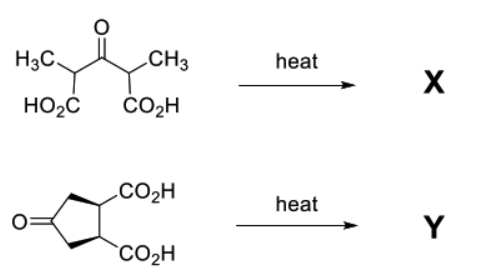
The sum of total number of carbonyl groups () present in the major products X and Y in the following reactions is ____.
Detailed Solution
The starting material is , which is a symmetric di--keto dicarboxylic acid.
In this molecule, both carboxylic acid () groups are located at the -position relative to the central ketone group.
Upon heating, -keto acids readily undergo decarboxylation (loss of ) via a 6-membered cyclic transition state. Because both sides of the ketone possess a -carboxyl group, the molecule will undergo double decarboxylation.
Reaction:
The major product is 3-pentanone.
Number of carbonyl groups () present in \textbf{X} = 1.
The starting material is 3,4-dicarboxycyclopentanone. Let's analyze the relative positions of its functional groups:
-
The ketone is at C1.
-
The carboxylic acid groups are at C3 and C4 of the ring.
For facile thermal decarboxylation, a molecule needs to be a -keto acid. However, the group at C3 is attached to the -carbon of the ring, meaning the carboxyl carbon itself is at the -position relative to the ketone. Thus, it acts as a -keto acid, which does \textit{not} undergo easy thermal decarboxylation.
Instead, the two groups are located on adjacent carbon atoms (C3 and C4), making it a 1,2-dicarboxylic acid (a vicinal diacid, chemically similar to succinic acid). When heated, 1,2-dicarboxylic acids readily undergo dehydration (loss of a water molecule, ) to form a highly stable 5-membered cyclic anhydride.
Reaction:
3,4-dicarboxycyclopentanone Cyclic Anhydride Derivative +
The major product \textbf{Y} is a bicyclic compound containing the original cyclopentanone ring fused with a newly formed cyclic anhydride ring. The structure of \textbf{Y} contains:
-
1 ketone carbonyl group () in the original ring.
-
2 carbonyl groups () as part of the new anhydride linkage ( ).
Total number of carbonyl groups () present in \textbf{Y} = 1 + 2 = 3.
The sum of the total number of carbonyl groups present in the major products \textbf{X} and \textbf{Y} is:
Sum = (Number of in X) + (Number of in Y) = 1 + 3 = 4.
Boost Your Exam Preparation!
Move beyond just reading solutions. Access our comprehensive Test Series, original Mock Tests, and interactive learning modules. Many premium tests are completely free!
- Original Mocks & Regular Test Series
- Real NTA-like Interface with Analytics
- Many Free Tests Available