Question 17
Elastic Collision and Oscillation in a Spring-Mass System
Two particles, 1 and 2, each of mass , are connected by a massless spring, and are on a horizontal frictionless plane, as shown in the figure. Initially, the two particles, with their center of mass at , are oscillating with amplitude and angular frequency . Thus, their positions at time are given by and , respectively, where . Particle 3 of mass moves towards this system with speed , and undergoes instantaneous elastic collision with particle 2, at time . Finally, particles 1 and 2 acquire a center of mass speed and oscillate with amplitude and the same angular frequency .
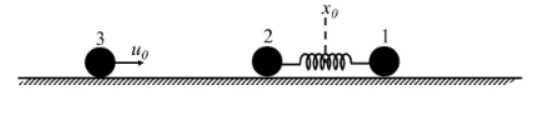
If the collision occurs at time , then the value of will be ________.
Detailed Solution
Step 1: Find state of system at . Velocities: and . Positions: . The equilibrium separation is , so the displacement from equilibrium is .
Step 2: Collision effects. Particle 3 hits particle 2 elastically. Velocity of particle 2 after collision is . Velocity of particle 1 remains .
Step 3: Energy calculation in CM frame. Relative velocity . Reduced mass and spring constant (since ). Energy of oscillation
Step 4: Relate energy to new amplitude . The energy for amplitude of each mass (relative amplitude ) is: Equating the energies:
Boost Your Exam Preparation!
Move beyond just reading solutions. Access our comprehensive Test Series, original Mock Tests, and interactive learning modules. Many premium tests are completely free!
- Original Mocks & Regular Test Series
- Real NTA-like Interface with Analytics
- Many Free Tests Available