Question 9
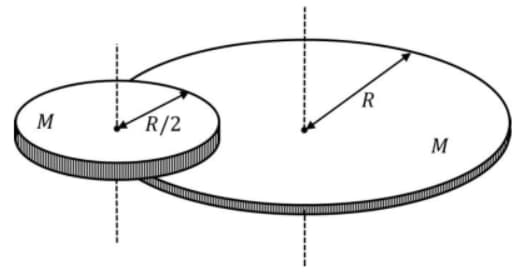
A disc of mass and radius is free to rotate about its vertical axis as shown in the figure. A battery-operated motor of negligible mass is fixed to this disc at a point on its circumference. Another disc of the same mass and radius is fixed to the motor's thin shaft. Initially, both the discs are at rest. The motor is switched on so that the smaller disc rotates at a uniform angular speed . If the angular speed at which the large disc rotates is , then the value of is _____.
Detailed Solution
Let the angular velocity of the large disc be . Since no external torque acts on the system about the central vertical axis, the total angular momentum of the system remains conserved.
Initial angular momentum of the system is .
The final angular momentum consists of three components evaluated about the central vertical axis:
- Spin angular momentum of the large disc:
- Orbital angular momentum of the small disc's center of mass (CM): The motor is fixed on the circumference, so the small disc's CM is at a distance from the central axis and moves with a linear velocity .
- Spin angular momentum of the small disc about its own CM: Because the problem states the small disc rotates at an angular speed without specifying a relative reference frame (like "relative to the motor"), it is conventionally taken with respect to the ground (inertial frame). The radius of the small disc is .
Equating the total final angular momentum to zero:
Dividing the entire equation by :
The magnitude of the angular speed of the large disc is . Therefore, the value of is .
Boost Your Exam Preparation!
Move beyond just reading solutions. Access our comprehensive Test Series, original Mock Tests, and interactive learning modules. Many premium tests are completely free!
- Original Mocks & Regular Test Series
- Real NTA-like Interface with Analytics
- Many Free Tests Available