Question 7
A glass beaker has a solid, plano-convex base of refractive index 1.60, as shown in the figure. The radius of curvature of the convex surface (SPU) is 9 cm, while the planar surface (STU) acts as a mirror. This beaker is filled with a liquid of refractive index up to the level QPR. If the image of a point object O at a height of (OT in the figure) is formed onto itself, then, which of the following option(s) is(are) correct?
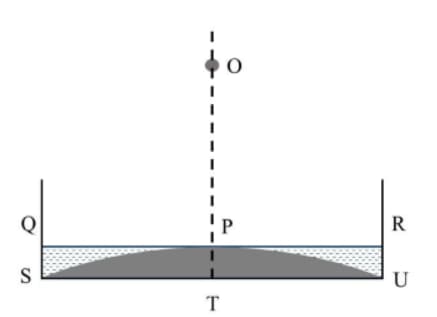
For cm.
For cm.
For cm.
For cm.
Detailed Solution
For the image to form on the object itself, light rays must strike the plane mirror (STU) normally. This means after refraction at the Air-Liquid and Liquid-Glass interfaces, the rays must be parallel to the principal axis.
Using the effective power of the silvered system or paraxial ray tracing:
-
Refraction at the flat liquid surface (at level QPR): The apparent position of O relative to the liquid surface is .
-
Refraction at the curved interface (SPU) with radius cm:
Using .
For the ray to strike the mirror normally, it must be parallel to the axis after refraction, so .
Here , , and .
Assuming the base is thin or is the distance to the effective surface:
is not quite right as is measured from .
Using the equivalent mirror approach where the object is at the center of curvature of the effective mirror:
.
(flat).
.
.
For image at object: .
Testing the options:
(A) cm. (Correct)
(B) cm. (Correct)
(C) cm. (Incorrect)
(D) cm. (Incorrect)
Boost Your Exam Preparation!
Move beyond just reading solutions. Access our comprehensive Test Series, original Mock Tests, and interactive learning modules. Many premium tests are completely free!
- Original Mocks & Regular Test Series
- Real NTA-like Interface with Analytics
- Many Free Tests Available