Question 6
Two uniform strings of mass per unit length and , and length and , respectively, are joined at point O, and tied at two fixed ends P and Q, as shown in the figure. The strings are under a uniform tension . If we define the frequency , which of the following statement(s) is(are) correct?
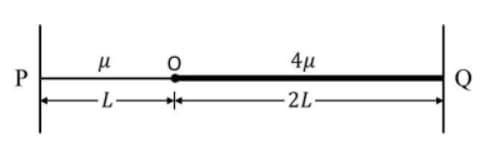
With a node at O, the minimum frequency of vibration of the composite string is .
With an antinode at O, the minimum frequency of vibration of the composite string is .
When the composite string vibrates at the minimum frequency with a node at O, it has 6 nodes, including the end nodes.
No vibrational mode with an antinode at O is possible for the composite string.
Detailed Solution
Let and be the wave speeds in the two strings.
and .
Given .
For a node at O:
Both segments must have an integer number of half-wavelengths.
and .
Equating the frequencies: .
For minimum frequency, , which gives .
. Thus (A) is correct.
Number of nodes: String 1 has nodes (P and O). String 2 has nodes. Total nodes = (overlapping at O) = 6. Thus (C) is correct.
For an antinode at O:
Each segment must have an odd multiple of quarter-wavelengths.
and .
Equating frequencies: .
Since the left side is even and the right side is odd, no integer solution for exists. Thus (D) is correct and (B) is incorrect.
Final Answer: A, C, D.
Boost Your Exam Preparation!
Move beyond just reading solutions. Access our comprehensive Test Series, original Mock Tests, and interactive learning modules. Many premium tests are completely free!
- Original Mocks & Regular Test Series
- Real NTA-like Interface with Analytics
- Many Free Tests Available