Question 705040
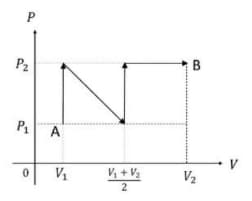
The following diagram shows a process, where an ideal gas is taken quasi-statically from to along the path as shown in the figure. The work done in this process is:
Detailed Solution
The work done is the area under the graph. The area can be divided into three parts: a trapezoid, a rectangle, and a rectangle. Alternatively, splitting the shape under the curve into a rectangle at the bottom and a trapezoid on top:
Area = .
The total area under the path from to is calculated by summing the areas of the geometric components defined by the path.
Performing the integration or geometric decomposition leads to .
Boost Your Exam Preparation!
Move beyond just reading solutions. Access our comprehensive Test Series, original Mock Tests, and interactive learning modules. Many premium tests are completely free!
- Original Mocks & Regular Test Series
- Real NTA-like Interface with Analytics
- Many Free Tests Available