Question 705034
SCQMEDIUM
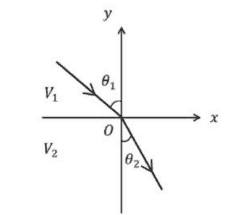
The region has a constant electrostatic potential and has a constant electrostatic potential . A charged particle with momentum is incident at an angle on the interface of the two regions. If the particle has momentum in the region , then the angle is given by
(A)
(B)
(C)
(D)
Detailed Solution
Since the potential is constant in each region, the force (which is the gradient of potential) is zero everywhere except at the interface (a delta-function potential). The tangential component of momentum parallel to the interface (-axis) is conserved.
Thus, .
Solving for , we get
.
Free Exam
Boost Your Exam Preparation!
Move beyond just reading solutions. Access our comprehensive Test Series, original Mock Tests, and interactive learning modules. Many premium tests are completely free!
- Original Mocks & Regular Test Series
- Real NTA-like Interface with Analytics
- Many Free Tests Available