Question 7
Six infinitely large and thin non-conducting sheets are fixed in configurations I and II. As shown in the figure, the sheets carry uniform surface charge densities which are indicated in terms of . The separation between any two consecutive sheets is . The various regions between the sheets are denoted as 1, 2, 3, 4 and 5. If , then which of the following statements is/are correct: (Take permittivity of free space )
(A) In region 4 of the configuration I, the magnitude of the electric field is zero. (B) In region 3 of the configuration II, the magnitude of the electric field is . (C) Potential difference between the first and the last sheets of the configuration I is . (D) Potential difference between the first and the last sheets of the configuration II is zero.
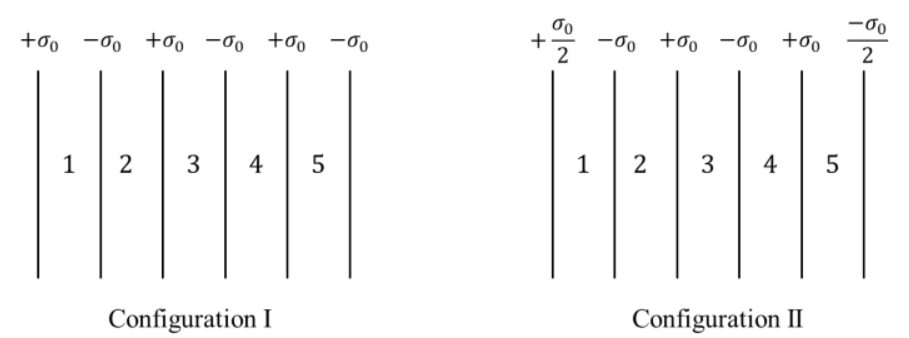
In region 4 of the configuration I, the magnitude of the electric field is zero.
In region 3 of the configuration II, the magnitude of the electric field is .
Potential difference between the first and the last sheets of the configuration I is .
Potential difference between the first and the last sheets of the configuration II is zero.
Detailed Solution
The electric field due to an infinite non-conducting sheet is . The net field in any region is .
Given and . (A) Config I: values are . In region 4 (between sheets 4 and 5), and . So . (A is correct).
(B) Config II: values are . In region 3, and . . Statement B says , so B is incorrect.
(C) In Config I, fields in regions 1, 3, 5 are and in regions 2, 4 are . . (C is incorrect).
(D) In Config II, fields in regions 1, 3, 5 are and in regions 2, 4 are .
Total . (D is incorrect).
Boost Your Exam Preparation!
Move beyond just reading solutions. Access our comprehensive Test Series, original Mock Tests, and interactive learning modules. Many premium tests are completely free!
- Original Mocks & Regular Test Series
- Real NTA-like Interface with Analytics
- Many Free Tests Available