Question 2
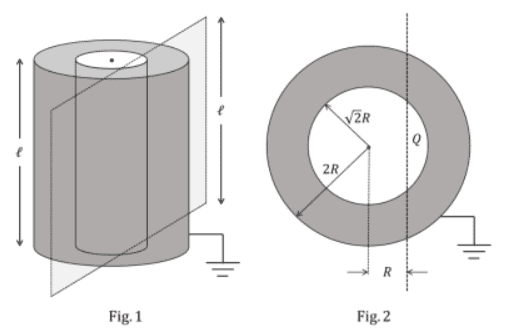
Two co-axial conducting cylinders of same length with radii and are kept, as shown in Fig. 1. The charge on the inner cylinder is and the outer cylinder is grounded. The annular region between the cylinders is filled with a material of dielectric constant . Consider an imaginary plane of the same length at a distance from the common axis of the cylinders. This plane is parallel to the axis of the cylinders. The cross-sectional view of this arrangement is shown in Fig. 2. Ignoring edge effects, the flux of the electric field through the plane is ( is the permittivity of free space):
Detailed Solution
The electric field in the dielectric region between the cylinders ( and ) is given by Gauss's Law:
Consider the plane at a distance from the axis. A point on this plane at a distance from its center has a radial distance from the axis .
The flux element through a strip of width and length is , where .
The plane intersects the dielectric region where .
This gives the limits for : Inner limit:
Outer limit:
The total flux is the integral over both segments (left and right sides of the chord):
Substituting : Thus, the correct option is (C).
Boost Your Exam Preparation!
Move beyond just reading solutions. Access our comprehensive Test Series, original Mock Tests, and interactive learning modules. Many premium tests are completely free!
- Original Mocks & Regular Test Series
- Real NTA-like Interface with Analytics
- Many Free Tests Available