Question 16
NUMERICALHARD
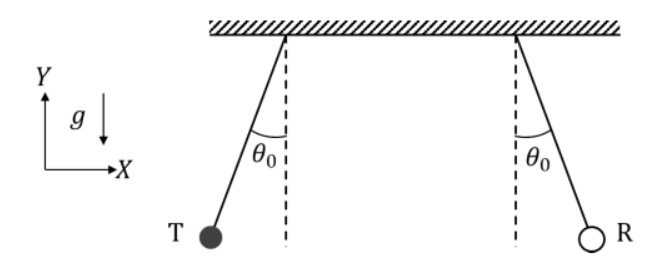
An audio transmitter (T) and a receiver (R) are hung vertically from two identical massless strings of length m with their pivots well separated along the axis. They are pulled from the equilibrium position in opposite directions along the axis by a small angular amplitude and released simultaneously. If the natural frequency of the transmitter is Hz and the speed of sound in air is m/s, the maximum variation in the frequency (in Hz) as measured by the receiver (Take the acceleration due to gravity m/s) is ___
Correct Answer: 32
Detailed Solution
- Maximum speed of pendulum: From conservation of energy, m/s.
- Both and have m/s at their respective equilibrium positions. Since they are released simultaneously in opposite directions, they move towards each other with maximum speed and away from each other with maximum speed.
- Maximum observed frequency (approaching): Hz.
- Minimum observed frequency (receding): Hz.
- Maximum variation: Hz.
Free Exam
Boost Your Exam Preparation!
Move beyond just reading solutions. Access our comprehensive Test Series, original Mock Tests, and interactive learning modules. Many premium tests are completely free!
- Original Mocks & Regular Test Series
- Real NTA-like Interface with Analytics
- Many Free Tests Available