Question 14
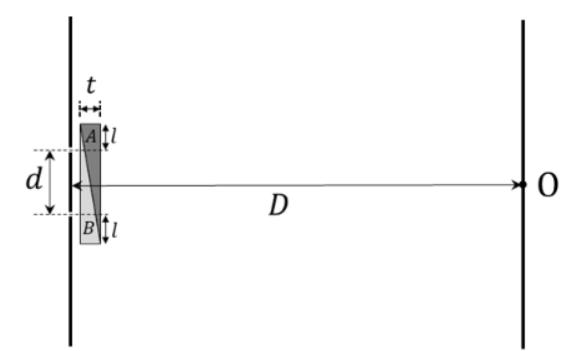
In a Young's double slit experiment, a combination of two glass wedges and , having refractive indices and , respectively, are placed in front of the slits, as shown in the figure. The separation between the slits is mm and the shortest distance between the slits and the screen is m. Thickness of the combination of the wedges is m. The value of as shown in the figure is mm. Neglect any refraction effect at the slanted interface of the wedges. Due to the combination of the wedges, the central maximum shifts (in mm) with respect to by ____
Detailed Solution
The shift of the central maximum in YDSE is caused by the extra optical path introduced by the transparent mediums in front of the slits. The shift () is given by , where is the optical path difference at the center.
Step 1: Determine the geometry of the wedge combination. Let the center between the two slits be the origin (). Since the slit separation is mm, the positions of the slits are:
- Top Slit (): mm
- Bottom Slit (): mm
From the figure, the wedge assembly extends a distance mm above and mm below .
- Top edge of the wedge is at mm.
- Bottom edge of the wedge is at mm. The total height of the wedge assembly is mm.
Step 2: Calculate the thickness of wedges at each slit. The thickness of wedge A () decreases linearly from at the top edge ( mm) to at the bottom edge ( mm). The thickness of wedge B () increases linearly from to . At any height , the thicknesses are proportional to the distance from the zero-thickness edge:
- At Slit 1 ( mm): Wedge A is of the way from the bottom, so . Wedge B is of the way from the top, so .
- At Slit 2 ( mm): By symmetry, and .
Step 3: Calculate the Optical Path Difference (). The extra optical path introduced at is The extra optical path introduced at is
The net path difference between the two waves arriving at the central point O is:
Step 4: Calculate the numerical shift. Given , , and m:
The shift of the central maximum is:
Final Answer: The central maximum shifts by 1.2 mm.
Boost Your Exam Preparation!
Move beyond just reading solutions. Access our comprehensive Test Series, original Mock Tests, and interactive learning modules. Many premium tests are completely free!
- Original Mocks & Regular Test Series
- Real NTA-like Interface with Analytics
- Many Free Tests Available