Question 5
A conducting square loop of side , mass and resistance is moving in the plane with its edges parallel to the and axes. The region has a uniform magnetic field, . The magnetic field is zero everywhere else. At time , the loop starts to enter the magnetic field with an initial velocity m/s, as shown in the figure. Considering the quantity in appropriate units, ignoring self-inductance of the loop and gravity, which of the following statements is/are correct:
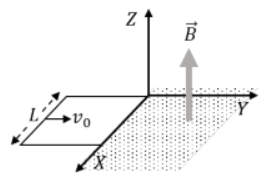
If , the loop will stop before it enters completely inside the region of magnetic field.
When the complete loop is inside the region of magnetic field, the net force acting on the loop is zero.
If , the loop comes to rest at .
If , the complete loop enters inside the region of magnetic field at time .
Detailed Solution
Let be the length of the loop that has entered the magnetic field. The induced emf is , and the induced current is . The magnetic force on the loop is , where .
- Equation of motion: . Integrating gives .
- In terms of position: . Integrating from to gives .
Analyze options: (A) To stop before entering completely (), the velocity must reach zero at . . For , . Thus it enters completely. Incorrect. (B) When the loop is fully inside, the magnetic flux is constant. Thus , , and the magnetic force is zero. Correct. (C) Based on , the velocity mathematically reaches zero only as . There is no finite time at which it 'comes to rest'. Incorrect. (D) For , the loop enters completely when . At this point, . Using , we have . Correct.
Boost Your Exam Preparation!
Move beyond just reading solutions. Access our comprehensive Test Series, original Mock Tests, and interactive learning modules. Many premium tests are completely free!
- Original Mocks & Regular Test Series
- Real NTA-like Interface with Analytics
- Many Free Tests Available