Question 4
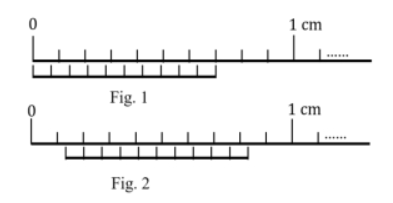
Figure 1 shows the configuration of main scale and Vernier scale before measurement. Fig. 2 shows the configuration corresponding to the measurement of diameter of a tube. The measured value of is:
0.12 cm
0.11 cm
0.13 cm
0.14 cm
Detailed Solution
Step 1: Determine the Least Count (LC) from Figure 1 From the first figure, we can see the main scale is calibrated such that 10 divisions make up 1 cm. Therefore, 1 Main Scale Division () = .
Looking at the alignment, 10 Vernier Scale Divisions (VSD) exactly coincide with 7 Main Scale Divisions (MSD). .
The Least Count (LC) of the Vernier caliper is given by: .
(Note: Figure 1 also shows that the zero of the Vernier scale aligns perfectly with the zero of the main scale, meaning there is no zero error).
Step 2: Read the measurement from Figure 2 In the second figure, the zero mark of the Vernier scale has crossed the first mark of the main scale (). So, the Main Scale Reading () = .
Next, we look for the Vernier Scale Coinciding Division (). The division of the Vernier scale perfectly aligns with a division on the main scale. So, .
Step 3: Calculate the Final Measured Value (D) The formula for the total reading is: .
Final Answer: The measured value of is .
Boost Your Exam Preparation!
Move beyond just reading solutions. Access our comprehensive Test Series, original Mock Tests, and interactive learning modules. Many premium tests are completely free!
- Original Mocks & Regular Test Series
- Real NTA-like Interface with Analytics
- Many Free Tests Available