Question 2
In a scattering experiment, a particle of mass collides with another particle of mass , which is initially at rest. Assuming the collision to be perfectly elastic, the maximum angular deviation of the heavier particle, as shown in the figure, in radians is:
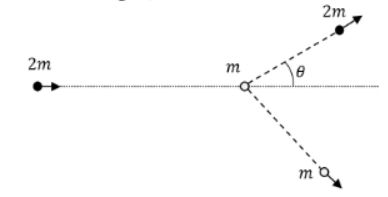
Detailed Solution
Let the initial velocity of the heavier particle () be , and its final velocity be at an angle with the initial direction. Let the final velocity of the lighter particle () be .
Step 1: Conservation of Linear Momentum Since there are no external forces, the initial momentum equals the final momentum:
Dividing the entire equation by :
To find the magnitude squared of , we take the dot product of with itself:
--- (Equation 1)
Step 2: Conservation of Kinetic Energy Because the collision is perfectly elastic, kinetic energy is conserved:
Multiplying the equation by to simplify: --- (Equation 2)
Step 3: Equating and forming a Quadratic Equation Equating the expressions for from Equation 1 and Equation 2:
Dividing by 2 and expanding:
Step 4: Condition for Real Roots (Maximum Angle) This is a quadratic equation in terms of . For a real physical collision to occur, the final velocity must be a real number. Therefore, the discriminant () of this quadratic equation must be greater than or equal to zero ().
Since is always positive, we get:
Taking the square root (considering is an acute angle in forward scattering):
For the maximum scattering angle , must be at its minimum allowable value:
Final Answer: The maximum angular deviation is radians.
Boost Your Exam Preparation!
Move beyond just reading solutions. Access our comprehensive Test Series, original Mock Tests, and interactive learning modules. Many premium tests are completely free!
- Original Mocks & Regular Test Series
- Real NTA-like Interface with Analytics
- Many Free Tests Available