Question 14
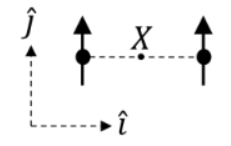
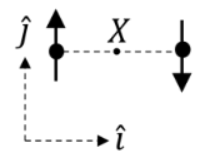
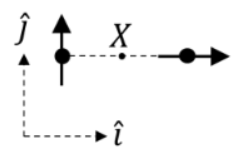
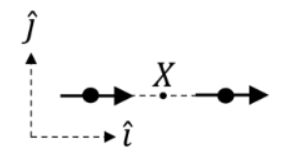
List-I shows four configurations, each consisting of a pair of ideal electric dipoles. Each dipole has a dipole moment of magnitude , oriented as marked by arrows in the figures. In all the configurations the dipoles are fixed such that they are at a distance apart along the direction. The midpoint of the line joining the two dipoles is . The possible resultant electric fields at are given in List-II.
Choose the option that describes the correct match between the entries in List-I to those in List-II.
List - I
List-II
Correct Match:
Detailed Solution
The electric field of an ideal dipole at distance is given by:
- Axial field: (same direction as )
- Equatorial field: (opposite direction to )
Let .
(P) Both dipoles are . Point is on the equatorial line for both dipoles located at . . Matches (2).
(Q) Left dipole is , right is . Point is on the equatorial line for both. . Matches (1).
(R) Left dipole is (equatorial for ), right is (axial for ). Total . Matches (4).
(S) Both dipoles are . Both are axial to . Total . Matches (5).
Correct matching: P-2, Q-1, R-4, S-5. This corresponds to option (C).
Boost Your Exam Preparation!
Move beyond just reading solutions. Access our comprehensive Test Series, original Mock Tests, and interactive learning modules. Many premium tests are completely free!
- Original Mocks & Regular Test Series
- Real NTA-like Interface with Analytics
- Many Free Tests Available