Question 1

SCQHARD

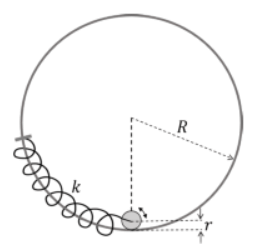
The center of a disk of radius rr and mass mm is attached to a spring of spring constant kk, inside a ring of radius R>rR > r as shown in the figure. The other end of the spring is attached on the periphery of the ring. Both the ring and the disk are in the same vertical plane. The disk can only roll along the inside periphery of the ring, without slipping. The spring can only be stretched or compressed along the periphery of the ring, following the Hooke's law. In equilibrium, the disk is at the bottom of the ring. Assuming small displacement of the disc, the time period of oscillation of center of mass of the disk is written as T=2ฯ€ฯ‰T = \frac{2\pi}{\omega}. The correct expression for ฯ‰\omega is (gg is the acceleration due to gravity):

Question
(A)

23(gRโˆ’r+km)\sqrt{\frac{2}{3} \left( \frac{g}{R - r} + \frac{k}{m} \right)}

(B)

2g3(Rโˆ’r)+km\sqrt{\frac{2g}{3(R - r)} + \frac{k}{m}}

(C)

16(gRโˆ’r+km)\sqrt{\frac{1}{6} \left( \frac{g}{R - r} + \frac{k}{m} \right)}

(D)

14(gRโˆ’r+km)\sqrt{\frac{1}{4} \left( \frac{g}{R - r} + \frac{k}{m} \right)}

Detailed Solution

Let ฮธ\theta be the small angular displacement of the center of the disk from the vertical. The distance of the center of the disk from the centre of the ring is Rโˆ’rR - r.

  1. The velocity of the centre of mass is v=(Rโˆ’r)ฮธห™v = (R - r) \dot{\theta}.

  2. For rolling without slipping, the angular velocity of the disc is ฯ‰disk=vr=(Rโˆ’r)ฮธห™r\omega_{disk} = \frac{v}{r} = \frac{(R - r) \dot{\theta}}{r}.

  3. Total Kinetic Energy K=12mv2+12Icmฯ‰disk2=12m(Rโˆ’r)2ฮธห™2+12(12mr2)((Rโˆ’r)ฮธห™r)2=34m(Rโˆ’r)2ฮธห™2K = \frac{1}{2} m v^2 + \frac{1}{2} I_{cm} \omega_{disk}^2 = \frac{1}{2} m (R - r)^2 \dot{\theta}^2 + \frac{1}{2} \left( \frac{1}{2} m r^2 \right) \left( \frac{(R - r) \dot{\theta}}{r} \right)^2 = \frac{3}{4} m (R - r)^2 \dot{\theta}^2.

  4. Potential Energy for small ฮธ\theta: U=Ugrav+Uspringโ‰ˆ12mg(Rโˆ’r)ฮธ2+12k((Rโˆ’r)ฮธ)2=12[mg(Rโˆ’r)+k(Rโˆ’r)2]ฮธ2U = U_{grav} + U_{spring} \approx \frac{1}{2} mg (R - r) \theta^2 + \frac{1}{2} k ((R - r) \theta)^2 = \frac{1}{2} [mg(R - r) + k(R - r)^2] \theta^2.

  5. Using conservation of energy d(K+U)dt=0\frac{d(K+U)}{dt} = 0:

32m(Rโˆ’r)2ฮธห™ฮธยจ+[mg(Rโˆ’r)+k(Rโˆ’r)2]ฮธฮธห™=0\frac{3}{2} m (R - r)^2 \dot{\theta} \ddot{\theta} + [mg(R - r) + k(R - r)^2] \theta \dot{\theta} = 0

ฮธยจ+2(mg(Rโˆ’r)+k(Rโˆ’r)2)3m(Rโˆ’r)2ฮธ=0\ddot{\theta} + \frac{2(mg(R - r) + k(R - r)^2)}{3m(R - r)^2} \theta = 0

ฯ‰2=23(gRโˆ’r+km)\omega^2 = \frac{2}{3} \left( \frac{g}{R - r} + \frac{k}{m} \right)

ฯ‰=23(gRโˆ’r+km)\omega = \sqrt{\frac{2}{3} \left( \frac{g}{R - r} + \frac{k}{m} \right)}

Free Exam

Boost Your Exam Preparation!

Move beyond just reading solutions. Access our comprehensive Test Series, original Mock Tests, and interactive learning modules. Many premium tests are completely free!

  • Original Mocks & Regular Test Series
  • Real NTA-like Interface with Analytics
  • Many Free Tests Available