Units and Measurement: The Convergence of Modern Science and Ancient Metrology
1. Introduction: Why Do We Need to Measure? (Historical Background)
Physics isn't just a game of formulas written on a blackboard; it is the science of understanding the world around us and surviving in it. If you think writing units like kilograms, meters, or seconds is only necessary to save marks in school exams, consider a historical incident from 1983.

Imagine flying at an altitude of 41,000 feet on Air Canada Flight 143 when suddenly, both engines shut down because the plane has run out of fuel. The aircraft was brand new, and there were no mechanical fuel leaks; instead, the near-disaster came down to a single unit conversion mistake. At that time, Canada had just implemented the metric system, but the ground crew calculated the fuel requirement in 'pounds' (lbs). The plane's modern computer, however, interpreted the incoming fuel data in kilograms (kg). Consequently, the plane was filled with only half the required fuel, causing the engines to stop mid-air. Fortunately, a skilful pilot glided the 100-tonne aircraft to a safe landing without engines, saving all 69 people on board. This event proved that merely having a number or magnitude for a physical quantity is never enough; its unit is its true identity.
The global confusion regarding units has deep historical roots. In the 1780s, France alone had over 250,000 different units for measuring length and weight. Every city and village had a distinct 'inch' and 'pound' that were often based on the physical body parts of kings, meaning the standard unit changed whenever the king changed. Poor farmers were ruthlessly exploited through taxes due to this "measurement fraud", which ultimately added fuel to the fire of the 1789 French Revolution. After the revolution, scientists of the newly liberated France decided to end the 'king's units' and developed a uniform system based on nature. From this, the metric system was born with the powerful motto: "For All People, For All Time".
2. Physical Quantities and the Global System
Now that we understand how crucial measurement is, we must define exactly what it is we are measuring. In physics, any property or concept that can be measured and through which the laws of physics can be expressed is called a 'physical quantity'. Examples include the speed of a car or the mass of a box, whereas abstract concepts like anger or happiness cannot be accurately measured with modern scientific instruments.
To express any physical quantity (), two components are absolutely essential:
-
Magnitude (): A numerical value.
-
Unit (): The standard reference.
This gives us the formula . It is important to note that if the unit is smaller, the magnitude will be larger, which is expressed mathematically as
.
Historically, scientists and engineers in different parts of the world created different systems of units according to their convenience. Three main systems became globally popular:
-
CGS System: Also known as the 'Gaussian System,' this originated in France for small-scale calculations and measures length in centimeters, mass in grams, and time in seconds.
-
FPS System: Known as the 'British Engineering System,' this measures length in feet, mass in pounds, and time in seconds. (This is the same system that put the Air Canada Gimli Glider in trouble!).
-
MKS System: As science advanced and work on large machines began, the MKS system was introduced, measuring length in meters, mass in kilograms, and time in seconds.
Notice a universal pattern: no matter which system is used in the world, the unit for measuring time has always remained the 'second.'
To unify these measurements, top scientists from all over the world gathered at an international conference (CGPM) in Paris in 1960 and adopted the International System of Units (SI). The SI System established 7 Fundamental Quantities, or "Pillars," to measure the entire universe. The modern definitions of these core units are fascinating:
-
Length (Meter - m): No longer based on a metal rod that expands with temperature, 1 Meter is now defined as the distance traveled by light in a vacuum in 1/299,792,458 of a second.
-
Mass (Kilogram - kg): For 130 years, 1 Kilogram was defined by a physical Platinum-Iridium cylinder kept in a vault in Paris. In a historic 2019 change, it was redefined through a constant of Quantum Mechanics—Planck's Constant—using a Kibble Balance.
-
Time (Second - s): Because the duration of a day is not perfectly fixed due to cosmic factors, we now use an 'Atomic Clock'. Today, 1 Second is exactly the time it takes for a Cesium-133 atom to vibrate 9,192,631,770 times.
The remaining four fundamental pillars added for specialized branches of science are Electric Current (Ampere), Thermodynamic Temperature (Kelvin), Amount of Substance (Mole), and Luminous Intensity (Candela).
3. The DNA of Physics: Dimensions and Their Magic
In physics, we measure hundreds of different things like speed, force, and energy. Instead of creating and memorizing thousands of separate units, scientists use a brilliant 'alphabet system.' If the 7 fundamental quantities are the "26 letters" of physics, derived quantities are the "words" formed by multiplying or dividing them.
The Dimensional Formula To express how these "letters" are combined, we use Dimensions. By definition, dimensions are the powers to which fundamental quantities are raised to express a physical quantity. This is written inside square brackets, using symbols like for Mass, for Length, and for Time.
For example, force is a crucial derived quantity calculated as mass acceleration. Because acceleration is , the dimensional formula for force becomes . Remembering this specific formula is a massive advantage for students, as it helps derive nearly 80% of all other physics formulas.
The Golden Rule (Principle of Homogeneity) Now we come to the most amazing and fun rule of physics. Imagine you have 5 apples and 3 oranges in a basket. If asked for the total number of apples, you cannot add them together and say "8 apples"—you can only add apples to apples and oranges to oranges.
Exactly the same thing happens in physics through the principle of homogeneity. This principle states that you can only add or subtract physical quantities whose dimensions are exactly the same. Therefore, if a formula is written as , it mathematically guarantees that the dimensions of all those terms are identical ().
The Detective Work of Physics Dimensions are not just for writing; they act like a 'detective' in physics. With their help, we can accomplish three major analytical tasks:
-
Checking the Correctness of a Formula: If you are in an exam and accidentally write , the dimensional balance will catch the mistake. Because the dimensions on the left-hand side () do not match the final term on the right-hand side (), you instantly know the formula is 100% wrong.
-
Deriving New Equations: If you know which variables influence a physical quantity, you can derive its formula without a single experiment. For instance, by knowing that the Time Period () of a simple pendulum depends on mass, length, and gravity, dimensional analysis allows us to mathematically derive the formula .
-
Finding Unknown Constants: This is a favorite concept for engineering entrance exams. Take the van der Waals equation for a gas: . Using our "Apple Rule", we know that since '' is subtracted from Volume (), '' must definitely have the dimension of Volume (). Likewise, since is added to Pressure (), its entire dimension must perfectly match the dimension of Pressure.
4. The Margin of Reality: Errors and Precision
The Mathematics of Mistakes So far, we have discussed concepts and formulas, but the reality is that no scientist or machine in the world can take a 100% perfect measurement of anything. In physics, this inevitable difference between the True Value and the Measured Value is known as an Error. Errors are not necessarily "mistakes," but natural limitations of measurement that are mainly divided into two types:
-
Systematic Errors: These are errors that tend to be in one direction, either always positive or always negative. Because we know their causes—such as a faulty instrument or environmental temperature changes—they can be minimized or corrected.
-
Random Errors: These occur irregularly and without any fixed pattern, like sudden voltage fluctuations. While they cannot be completely eliminated, they can be minimized by taking multiple readings and calculating their Average.
The Snowball Effect (Propagation of Errors) Imagine you measured the length of a rectangle and made a slight error, then made another slight error while measuring its breadth. When you multiply them to find the Area, what happens to the error? This is called the Propagation of Errors.
The Golden Rule of Errors is absolute: whether you add, subtract, multiply, or divide quantities, errors are always added. You cannot cancel one error by making another error.
-
Addition and Subtraction: Their Absolute Errors are directly added.
-
Multiplication and Division: Their Relative or Percentage Errors are added.
-
Power of a Quantity: If there is a power on a quantity, that power is directly multiplied by the Percentage Error of that specific quantity.
Significant Figures (The Digits of Trust) According to standard mathematics, 2.5 and 2.500 are exactly the same. But according to physics, there is a world of difference between the two. Writing 2.500 cm means that your measuring instrument is 100% reliable (precise) up to three decimal places. These reliable digits are called Significant Figures, and there are strict rules for counting them:
-
"Trapped" Zeroes: Zeroes caught between two non-zero digits are always counted.
-
Leading Zeroes: The starting zeroes are never significant; they are only there to indicate the position of the decimal point.
-
Trailing Zeroes: If a number does not have a decimal point (e.g., 1500 m), trailing zeroes are not significant. However, trailing zeroes after a decimal point (e.g., 2.500 cm) ARE significant because they represent the precision of the instrument.
Instruments of Precision To achieve greater precision, physicists rely on specialized instruments.
- The Vernier Caliper: This tool features a sliding mechanism where a smaller vernier scale slides over a fixed main scale. Its ultimate precision is defined by its Least Count (LC), which is calculated as the difference between one Main Scale Division (MSD) and one Vernier Scale Division (VSD).
- The Screw Gauge (Micrometer): This instrument works on the 'Screw Principle' using a fixed pitch scale and a rotating circular scale. When you give the circular scale one full rotation, the distance it moves forward is called the 'pitch.' By dividing the pitch by the total divisions on the circular scale, you get its least count, making it much more precise than a vernier caliper. To know more about how a screw gauge works, watch the following video:
Both instruments can develop a "zero error" due to continuous wear and tear. The correction rule for both is universal: a positive zero error is always subtracted from the final reading, while a negative zero error is always added to it.
5. Indian Knowledge System (IKS): Ancient Jain Metrology
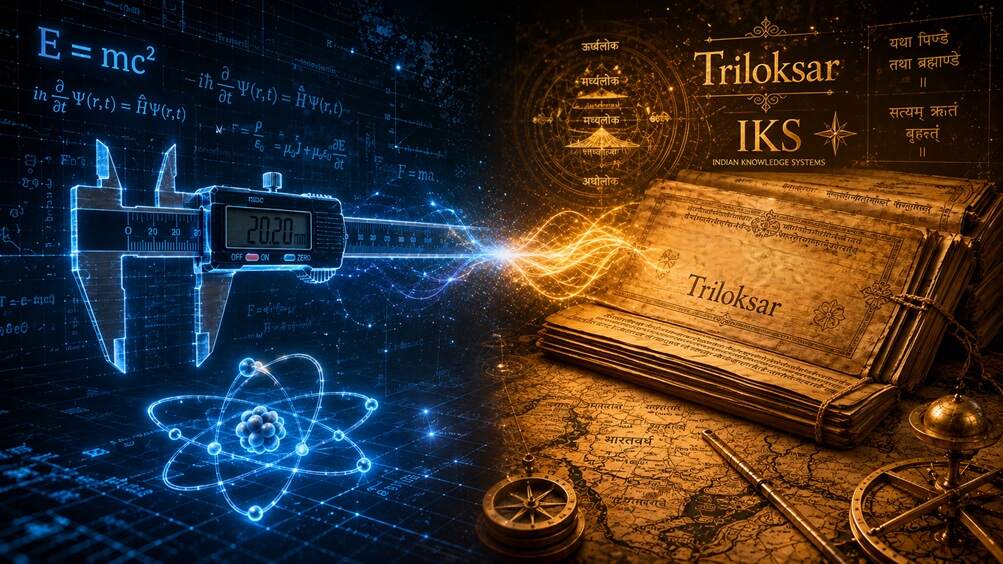
The SI System and Quantum Mechanics of modern physics have barely been around for a century. However, thousands of years ago, ancient Indian science—specifically Jain Karnanuyog texts like Triloksaar and Tilloyapannti—had already documented a highly advanced measurement system. This ancient framework accurately measured everything from the absolute quantum (micro) level to the vast cosmos (macro).
The 4D Measurement System Modern physics primarily focuses on measuring 'Physical Quantities' like mass and length. In stark contrast, Jain metrology was far more holistic, measuring reality across four distinct dimensions (4D): Dravya (Matter), Kshetra (Space), Kaal (Time), and Bhaav (Intensity or Emotions).
The Quantum of Space & Matter Modern science today acknowledges that space is not infinitely continuous, relying on concepts like the 'Planck Length' and 'Quarks'. Jain science defined these fundamental limits thousands of years ago through two core concepts:
-
Parmaanu: The absolute smallest, ultimate indivisible part of matter (Pudgala). This concept is largely equivalent to modern 'quarks', or point particles.
-
Pradesh: The "pixel" of reality. It is the smallest volume of space (Akash) that can accommodate exactly one Parmaanu and cannot be divided any further.
The Ultimate Chronometer (Kaal) In Jain metrology, time does not flow in a continuous, unbreakable stream; rather, it progresses in discrete units. The smallest, indivisible unit of time is known as Samay. It is ingeniously defined as the exact time taken for a single Parmaanu to cross one Pradesh point.
Cosmic Distances & Dimensional Analysis While modern astronomers use 'light-years' to measure intergalactic space, Jain science utilized a massive cosmic unit called the Rajju. Calculations, from a perspective, reveal that 1 Rajju is at least approximately equal to 240 million light-years. What is truly remarkable is how texts like the Tilloyapannti perfectly utilized what we now call dimensional analysis to map the universe. They defined cosmic dimensions using 'Pratara' (Area ) and 'Ghan' (Volume ). Using this deep mathematics, the Jain Universe is beautifully described as a volume of 343 cubic Rajju ().
Measuring Emotions (Bhaav) Perhaps the most fascinating aspect of this ancient wisdom is its ability to quantify the abstract. While modern science cannot accurately measure feelings with instruments, ancient Jain Karnanuyog featured an extremely advanced mathematical model to measure 'Bhaav' (emotions or the intensity of the soul's state). They designed specific quantum units known as Avibhag Pratichhed to measure these abstract concepts, proving that the ancient Indian Knowledge System was incredibly comprehensive. For a deeper insight of this IKS explanation, watch the following video on Jain units and measurement:
6. Conclusion
Measurement is far more than just writing a number next to a unit to score marks in an exam. As we saw with the Gimli Glider crisis, it is a crucial framework for survival and the fundamental language we use to decode the universe. From the chaotic days of the French Revolution to the modern, hyper-precise SI System driven by quantum constants and atomic clocks, our quest for accurate measurement has continuously shaped modern science.
Yet, our journey through the Indian Knowledge System (IKS) proves that this quest for ultimate precision is not entirely new. Thousands of years before modern quantum mechanics, ancient Jain Karnanuyog texts mapped out a staggering 4D reality—measuring not just matter and space, but time and abstract emotions. Whether we are looking at the universe through the lens of modern quarks and the Planck length or the ancient Parmaanu and Pradesh, the ultimate goal remains exactly the same: to understand the profound mechanics of the cosmos.
Start Your Preparation in a Structured Way
Create a free account on Vidyaaytan Prep to access interactive study, mock tests, PYQs, analytics, and focused preparation tools.
Discussion
I hope more basic things needs to come with elaborately
Thank you for your valuable feedback! I'm glad you read the blog. In our upcoming posts and content, we will definitely focus on breaking down foundational physics concepts even more elaborately with step-by-step examples. Stay tuned!
Great perspective!