The Forgotten Wealth: Healing the Global Economic Crisis with Sustainable Roots
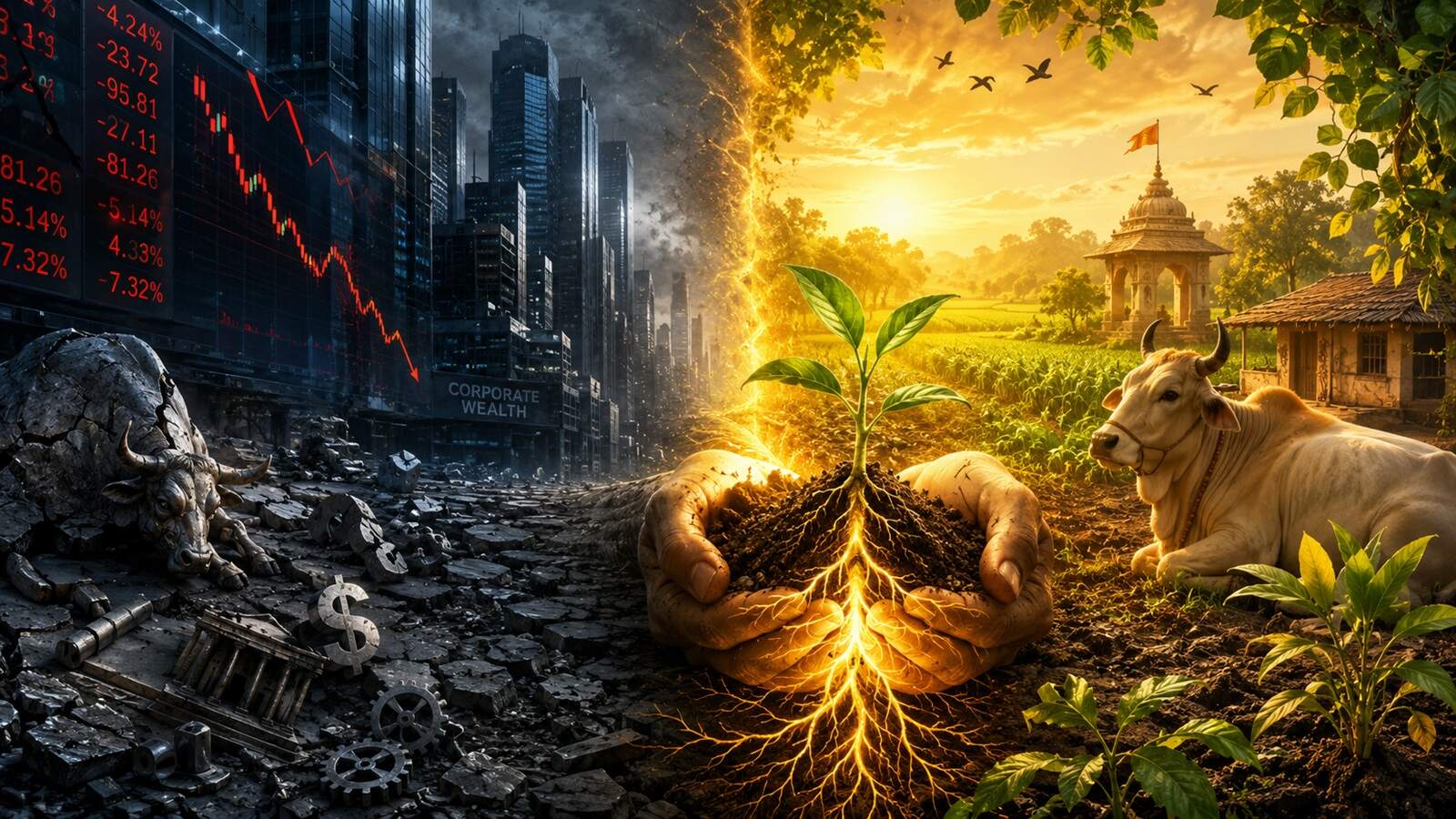
1. Introduction: The Glittering Illusion of the Modern World
When we look at the 21st century from the outside, it presents a dazzling spectacle of human achievement. We are living in an era defined by breathtaking technological advancements, hyper-connectivity, and a towering modern infrastructure that spans the globe. The world moves at an unprecedented pace, with information, luxury, and digital conveniences available instantly at our fingertips. On the surface, modern civilisation appears to have reached the absolute zenith of progress, painting a picture of a society that is endlessly wealthy, efficient, and invincible. This outward shine, driven by rapid industrialisation and a booming corporate landscape, makes it incredibly easy to believe that we are living in the most prosperous time in human history.
However, beneath this glittering facade lies a deeply unsettling reality. This outward shine masks a profound internal hollowness that is quietly eroding the foundation of our society. While our digital screens and corporate ledgers display expanding numbers, we are collectively losing our most precious assets: our mental peace, our physical health, and our fundamental human values. The relentless, high-stress modern lifestyle has commodified existence, leading to a synthetic way of living that leaves us disconnected from nature and drained of genuine vitality. Worse still, this artificial prosperity is structurally fragile, pushing the global economy toward a devastating and inevitable crisis. We have traded the enduring, life-sustaining wealth of our roots for a hollow illusion, and the devastating cracks in this modern paradigm are finally beginning to show.
2. The Golden Era of Sustainable Prosperity
To understand the depth of our current crisis, we must look back 800 to 1,000 years to an era when India and the broader world experienced genuine, unwavering economic prosperity. For centuries, India was universally revered as the "Sone ki Chidiya" (The Golden Bird) of the world. This title was not earned through speculative corporate trading or volatile stock markets but through real, tangible abundance. The absolute bedrock of this immense wealth was Gau-aadharit prakritik krishi (cow-based natural agriculture). Unlike today’s fragile economic climate—where wealth is tied to abstract digital numbers that can crash overnight—historical wealth was stable, grounded in the earth, and directly beneficial to the masses. A society's wealth was measured in fertile soil, healthy cattle, and overflowing granaries, creating a robust, decentralised economy where local communities thrived and nature was enriched rather than exploited.
The architectural blueprint for this sustainable society was not a recent invention; it was laid in prehistoric times by the first Jain Tirthankar, Lord Rishabhdev. To transition humanity into a civilised, self-reliant era, he established the six foundational pillars of human society: Asi (defence and security), Masi (writing and administration), Krishi (agriculture), Vidya (knowledge and arts), Vanijya (trade and commerce), and Shilp (crafts and architecture). For millennia, these six skills formed the unbreakable root of India’s social, political, and economic structure. It was a perfectly balanced ecosystem where commerce (Vanijya) supported agriculture (Krishi) rather than exploiting it and where all progress was designed to elevate human life without destroying mental peace. This holistic equilibrium allowed civilisation to flourish for thousands of years, generating a kind of true, enduring prosperity that the modern corporate world has completely failed to replicate.
3. The Root of the Crisis: Corporate Culture vs. Sustainable Economics
The shift from the golden era of sustainable prosperity to our current crisis was not a natural evolution; it was a calculated pivot driven by corporate greed. As the Industrial Revolution took hold, the emerging corporate structures required a massive, centralised workforce and endless, cheap raw materials. To facilitate this industrial boom, the self-sustaining, community-centric model of traditional agriculture was deliberately dismantled. Farming was no longer viewed as a sacred, life-giving partnership with nature. Instead, it was aggressively rebranded as a mechanical industry—a factory without a roof—designed solely to maximise output and fuel the growing corporate machine. This marked the beginning of an economic system where nature was commodified, and human values were subordinated to profit margins.
The drive to monopolise agriculture began in the early 20th century, when hybrid seed research—initially pursued as a yield-improvement science—was gradually transformed by corporate laboratories into a tool for controlling the food supply, since these seeds could not be saved and replanted by farmers year after year. However, the most devastating blow to sustainable economics came in the aftermath of World War II, which provided the perfect opportunity to impose this corporate control on a massive, global scale. When the war ended, massive multinational arms factories—which had produced immense quantities of nitrogen for explosives and toxic compounds for nerve agents—suddenly faced a peacetime drop in demand. In a tragic and profit-driven rebranding, these weapons-grade chemicals were repackaged and introduced to global farming as synthetic chemical fertilisers and deadly pesticides (keetnashak). The pre-planned hybrid seeds were then aggressively imposed alongside these chemicals, as they were specifically bred to depend on this new, toxic environment.
This militarisation of agriculture did not stop at chemicals; it also transformed the machinery. The very same assembly lines that had manufactured heavy tanks and military vehicles during the war were rapidly repurposed to mass-produce heavy agricultural tractors, a shift seen across major wartime manufacturers including companies like Ford and Caterpillar. In countries like India, farming was traditionally done using oxen (bulls), which naturally tilled and maintained the soft, porous, and aerated texture of the soil. The sudden introduction of these multi-tonne heavy tractors severely crushed and compacted the earth, turning it into a hard, impermeable layer. This unnatural compaction completely destroyed the soil's natural water retention capacity, leading to rapid rainwater runoff and the devastating depletion of groundwater levels.
Together, these elements created a vicious, inescapable trap for the farmer and the consumer alike. Farmers were completely stripped of their self-reliance; they could no longer save their traditional, climate-resilient seeds from year to year. Instead, they were forced into a lifelong dependency—buying corporate hybrid seeds that required corporate chemical fertilisers to grow and corporate pesticides to survive, all while their soil died under the weight of heavy machinery. This relentless, hollow drive has manufactured a looming economic and health crisis. By transforming food from a source of holistic nourishment into a patented, toxic commodity, corporate culture has completely stripped away our ecological balance. The soil is left barren, our health is deteriorating, and the real wealth that once enriched local communities is now endlessly syphoned into the overflowing bank accounts of multinational corporations.
4. The Great Forgetting: What is "Real Wealth"?
In the modern rush for endless economic growth, humanity has suffered from a profound collective amnesia—a Great Forgetting of what "wealth" actually means. Today, we measure prosperity in fluctuating fiat currencies, paper money, and digital digits glowing on corporate bank ledgers. We have been conditioned by a hollow corporate culture to believe that accumulating these abstract symbols is the ultimate goal of life. Yet, if the global supply chains were to collapse tomorrow, a billion dollars in a digital account could not produce a single drop of water or a grain of wheat. These financial constructs are not real wealth; they are merely agreed-upon illusions. True prosperity, the kind that historically anchored great civilizations, can only come from resources that tangibly sustain and nurture human life.
When we strip away the artificial complexities of modern economics, we arrive at a powerful, undeniable truth: it is only natural, traditional agriculture—what we now call regenerative farming—that holds the power to produce real wealth. Traditional farming is the only human endeavour that partners with the earth to create true abundance. Consider the mathematical miracle of a natural seed. When a farmer sows a strictly limited handful of seeds into fertile, chemical-free soil, nature performs an act of exponential multiplication. That small handful yields a massive harvest of vibrant, life-sustaining, and critically, reusable seeds. Whether it is grains to feed the masses, protein-rich pulses, nourishing fruits and vegetables, or cotton to clothe society, traditional farming generates a perpetual cycle of living abundance. This is the very definition of genuine wealth creation.
Contrast this natural miracle with what the modern world mistakenly glorifies as "wealth generation." Industrial activities, such as extracting gold from deep mines, drilling for fossil fuels, or manufacturing synthetic goods, do not actually create new wealth. They are merely acts of extraction and relocation. A gold mine is a finite, dead resource; it simply moves existing metal from the ground to a vault, and once the mine is emptied, it is gone forever, leaving behind a scarred earth. But a plot of land, nurtured through traditional, natural farming, never depletes. It regenerates. It produces fresh, living wealth year after year, century after century. True economic security lies not in the lifeless vaults of banks, but in the living, breathing soil of a naturally cultivated farm.
5. The Ultimate Solution: Returning to Natural Agriculture
To escape the impending global economic and health crisis, the answer does not lie in yet another corporate technological disruption. Instead, it requires a profound return to our roots: ancient traditional agriculture, widely recognised today as natural or regenerative farming. For millennia, this practice was the undisputed engine of global prosperity and the absolute backbone of human survival. It is a system built on ecological symbiosis and self-reliance, rather than engineered corporate dependence. By reintroducing natural agriculture on a mass scale, we shift the power of wealth creation away from multinational conglomerates and place it back into the hands of local communities and farmers.
At the heart of this ancient wisdom is the practice of Gau-aadharit (cow-based) farming, which creates a self-sustaining, zero-waste economy. Today, methods like "Zero Budget Natural Farming" (ZBNF) and "Rishi Kheti" are gaining global popularity, proving that ancient, non-violent principles are highly scientific and practical. In this closed-loop system, the farmer does not need to purchase expensive, toxic chemical fertilisers or patented seeds. Instead, the soil is enriched naturally through traditional methods:
- Ghan-Jivamrit (Dry Microbial Culture): Rather than rotting wet manure, fresh cow dung is immediately mixed with gram flour, jaggery, and soil, then sun-dried. This preserves essential soil bacteria without breeding harmful pests. When added to the field, it activates slowly with rainwater to nourish the earth naturally.
- Mulching (Aachhadan): The soil is never left naked; it is covered with dry leaves, grass, or crop residue. This layer retains moisture and naturally turns into compost over time. It mimics the natural ecosystem of a forest, encouraging earthworms to surface and work automatically without forced decomposition.
- Green Manure & Intercropping: Cultivating natural nitrogen-fixers (like beans or sunn hemp) and employing intercropping (like growing wheat alongside chickpeas). The chickpea roots pull pure nitrogen from the air to feed the wheat—a perfect example of ecological cooperation without the need for rotting waste.
- Natural Decomposition: Using eco-friendly solutions (like waste decomposers) mixed with jaggery water to rapidly break down dry crop residues directly in the field, eliminating the need to transport external compost.
Modern science is finally validating what was known during the era of Lord Adinath: "Feed the soil, not the plant." If you cover the soil and maintain diverse roots, the earth remains perpetually fertile. Because these inputs are virtually free and sourced from within the farm itself, the farmer is completely liberated from the vicious, modern cycle of agricultural debt. This creates true, decentralised economic stability at the grassroots level. When rural economies thrive organically, the entire nation's economic foundation becomes unshakeable, insulated from the volatile crashes of global stock markets.
Beyond economics, a return to natural agriculture is the only viable solution for restoring our collective physical and mental well-being. Today’s chemical-laden, highly processed crops are directly responsible for the catastrophic decline in global health and the exponential rise in chronic diseases. Natural farming restores the fundamental purity and nutritional density of our food, acting as preventive medicine for the masses. Simultaneously, it restores mental peace. A society that eats pure food and a farming community free from crushing corporate debt naturally experience a profound psychological relief. By embracing the agricultural wisdom of our ancestors, we do not just save the economy; we heal the earth, nourish our bodies, and reclaim our peace of mind.
6. The Economics of Compassion: True Cow Protection Through Agriculture
In India, there is a deep-rooted cultural movement led by compassionate individuals, Dharmik groups, and animal lovers (jeev daya premi) who work tirelessly to protect cows from abandonment and slaughter. However, relying solely on emotional appeals, charity, or isolated cow shelters (Gaushalas) is not a sustainable, long-term solution. The harsh reality is that simply wanting to save the cow will not secure its future; an animal that is viewed by the modern system as a financial burden once it stops giving milk will always remain at risk.
The only permanent, practical solution to cow protection lies in fundamentally shifting our ecosystem back to cow-based agriculture (Gau-aadharit krishi). When farmers transition to natural farming, the cattle family is no longer judged solely by dairy production. Crucially, the oxen (bulls) return to their rightful place ploughing the fields. Unlike multi-tonne heavy tractors that violently crush the earth and destroy its water-retention capacity, oxen gently till the land, keeping the soil soft, porous, and naturally aerated.
Furthermore, the cow's byproducts—specifically cow dung and cow urine (gaumutra)—transform into invaluable, wealth-generating agricultural inputs (such as Ghan-Jivamrit) that completely replace expensive, toxic chemical fertilisers and pesticides. By integrating these elements—the gentle, soil-preserving ploughing of the ox and the enriching inputs of the cow—into daily farming, the cattle become an indispensable economic asset to the farmer's livelihood. When the cow is the very foundation of agricultural wealth, its protection becomes automatic and effortless. We do not need to artificially 'save' the cow through charity; we simply need to restore its rightful place at the heart of our agricultural economy, ensuring it is organically protected, nurtured, and revered by the very farmers whose land it enriches.
7. Conclusion: Breaking the Cycle and Rebuilding the Future
The battle between corporate exploitation and natural sustainability is not just a theoretical concept; it is happening right now on the ground. The current agrarian distress and the ongoing farmer protests (Kisan Aandolan) in India are not isolated political events—they are the desperate cries of a historically self-reliant community fighting against a deeply flawed global system. Today, massive multinational corporations and global powers are actively using forced international treaties, such as heavily biased WTO agreements, to corner India. Their objective is clear: to exert immense pressure on the nation to accept policies that systematically dismantle agricultural independence. These agreements are designed to make it legally and economically impossible for Indian farmers to grow crops independently or return to natural, traditional farming. The ultimate goal of these global lobbies is to break India's self-sufficiency, ensuring that a nation that once fed the world becomes entirely dependent on foreign, corporate-controlled food systems.
To break free from this vicious cycle, the Indian government must stand exceptionally firm and categorically reject these exploitative international agreements. Surrendering to this global corporate pressure is not just an economic compromise; it is a surrender of our food sovereignty and our future. Rebuilding our world requires a massive, unyielding grassroots movement to restore and promote traditional natural farming on a grand scale. We must protect our farmers, our indigenous seeds, and our sacred soil from corporate hijacking. By choosing to reject the hollow corporate agricultural model and embracing the wisdom of our ancient, Prakritik farming traditions, India will not just secure its own economic and physical health. It will pave the way for true global welfare (Vishwa Kalyan), offering the rest of the world a proven blueprint to heal the economy, restore humanity, and reclaim the forgotten wealth of our ancestors.
Start Your Preparation in a Structured Way
Create a free account on Vidyaaytan Prep to access interactive study, mock tests, PYQs, analytics, and focused preparation tools.
Discussion
डोळ्यात जळजळीत अंजन घालणारा अभ्यासपूर्ण लेख .... अनेक दशकांपासून भारतावर लादली गेलेली ही कृत्रिम खते कृत्रिम बियाणे आणि ट्रॅक्टर यांनी आपली संपन्न भूमी निकृष्ट केली आहे. आपण सांगितलेल्या उपायांनी ती निकृष्ट भूमी पुन्हा संपन्न होण्यास किती काळ लागेल? त्यासाठी शहरवासीयांनी काय केले पाहिजे?
आपने बिल्कुल सही और महत्वपूर्ण मुद्दे उठाए हैं।१. भूमि को फिर से उपजाऊ होने में कितना समय लगेगा?तत्काल बदलाव: प्रकृति की खुद को ठीक करने की क्षमता अद्भुत है। यदि हम 'घन-जीवामृत' और 'मल्चिंग' (Mulching/आच्छादन) जैसी प्राकृतिक पद्धतियों का उपयोग शुरू करें, तो पहले ही साल से मिट्टी में सकारात्मक बदलाव (केंचुए और सूक्ष्मजीव) दिखने लगते हैं।पूर्ण उपजाऊपन: रासायनिक खादों के कारण पूरी तरह खराब हो चुकी भूमि को फिर से जीवित और समृद्ध होने में आमतौर पर २ से ३ साल (३ सीजन) का समय लगता है।२. शहरवासियों को क्या करना चाहिए?इस पूरे आंदोलन में शहरवासियों (शहरी उपभोक्ताओं) की भूमिका सबसे महत्वपूर्ण है:सीधी खरीदारी: कॉपोरेट बिचौलियों (Middlemen) की चेन को तोड़कर, प्राकृतिक खेती करने वाले किसानों से सीधे अनाज, दालें और सब्जियां खरीदें।मांग पैदा करना: जब शहर के लोग 'विषमुक्त' (Chemical-free) भोजन की मांग बढ़ाएंगे, तो किसान अपने आप प्राकृतिक खेती की ओर आकर्षित होंगे।सच्चा गो-संवर्धन: केवल भावनात्मक न होकर, ऐसी गौशलाओं और किसानों की मदद करें जो गोमूत्र और गोबर का उपयोग सीधे खेती (खाद) के लिए कर रहे हैं।यह व्यवस्था बदलने की लड़ाई हम सबकी है। लेख पढ़कर इतनी सुंदर और विचारणीय प्रतिक्रिया देने के लिए आपका फिर से बहुत-बहुत आभार! 🙏
Very well written, thank you for providing the deep insights on this fundamental issue.
आपण डोळ्यात जळजळीत अंजन घालणारा अभ्यास पूर्ण लेख लिहिला आहे. आपले अभिनंदन आणि धन्यवाद. कृत्रिम खते, कृत्रिम बियाणे आणि ट्रॅक्टर्स यांच्या साह्याने गेली अनेक दशके आपण आपली संपन्न भूमी निकृष्ट केली आहे. ती पुन्हा संपन्न करण्यासाठी किती काळ लागेल? आमच्यासारख्या शहरवासीयांनी त्यासाठी काय केले पाहिजे?
तुम्ही अगदी योग्य मुद्दे उपस्थित केले आहेत. १. भूमी पुन्हा संपन्न होण्यास किती काळ लागेल? निसर्गाची स्वतःला बरं करण्याची क्षमता अफाट आहे. जर आपण 'घन-जीवामृत' आणि 'आच्छादन' (Mulching) सारख्या नैसर्गिक पद्धतींचा योग्य वापर केला, तर पहिल्याच वर्षापासून जमिनीत सकारात्मक बदल (गांडूळ आणि सूक्ष्मजीव) दिसू लागतात. पूर्णपणे निकृष्ट झालेली जमीन पुन्हा सुपीक आणि जिवंत होण्यासाठी साधारणपणे २-३ वर्षांचा (३ हंगामांचा) काळ लागतो. २. शहरवासीयांनी काय केले पाहिजे? या चळवळीत शहरवासीयांची भूमिका सर्वात मोठी आहे: थेट खरेदी: कॉर्पोरेट साखळी (Middlemen) मोडून नैसर्गिक शेती करणाऱ्या शेतकऱ्यांकडून थेट धान्य, डाळी आणि भाजीपाला विकत घ्या. मागणी निर्माण करणे: जेव्हा शहरातील लोक 'विषमुक्त' अन्नाची मागणी वाढवतील, तेव्हा आपोआप अधिक शेतकरी नैसर्गिक शेतीकडे वळतील. खरे गो-संवर्धन: केवळ भावनिक न होता, अशा गोशाळांना आणि शेतकऱ्यांना पाठिंबा द्या जे गोमूत्र आणि शेणाचा वापर प्रत्यक्ष शेतीसाठी (खत म्हणून) करतात. ही व्यवस्था बदलण्याची लढाई आपल्या सर्वांची आहे. लेख वाचून इतका सुंदर अभिप्राय दिल्याबद्दल पुन्हा एकदा आभार!