Forces, Energy, and Symmetry: How Physics Rewrote Its Own Rules
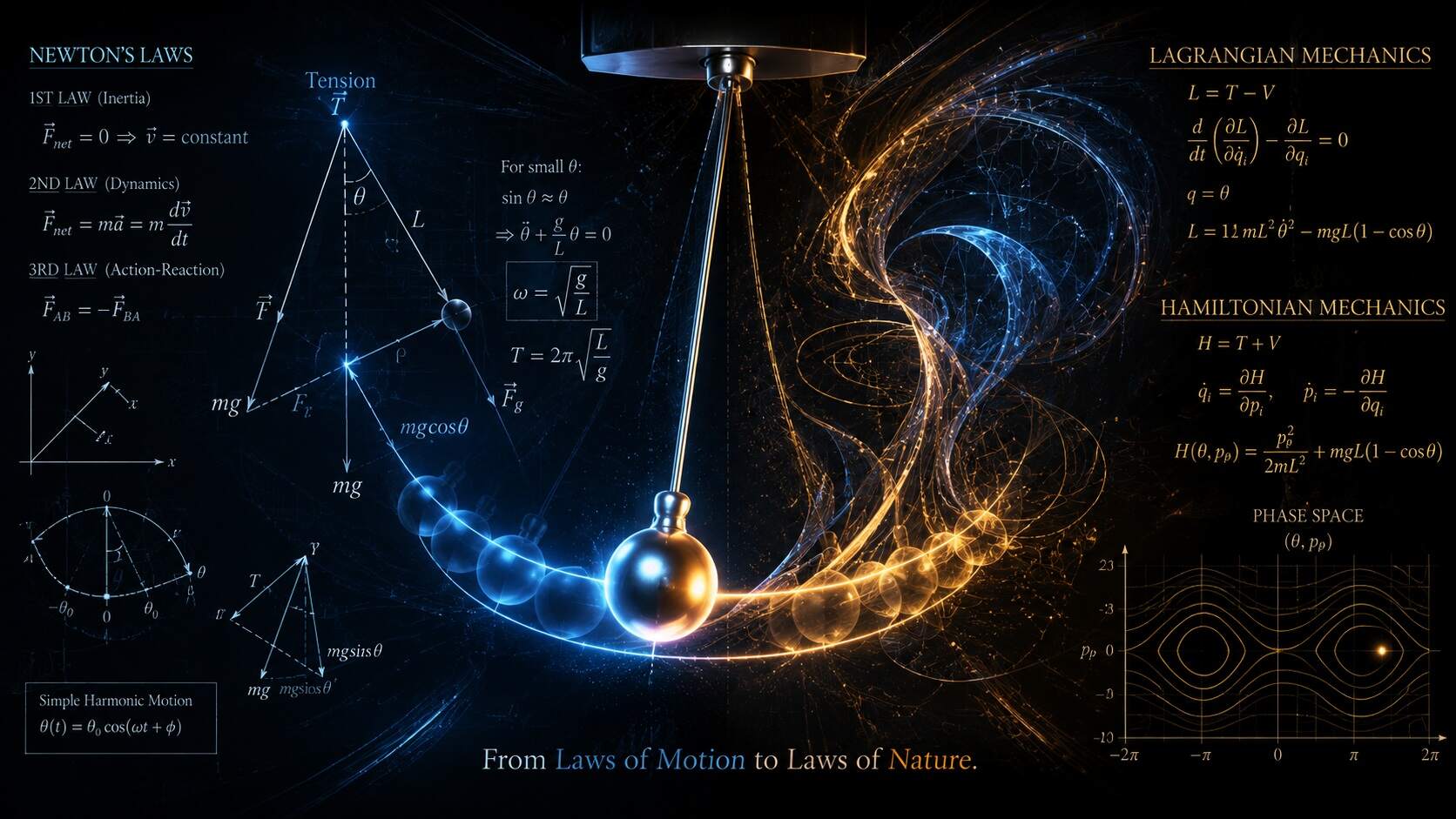
The Newtonian Foundation (The Language of Vectors)
The Dawn of Mechanics: 1687 and the Principia
To truly appreciate how far physics has come, we have to travel back to the year 1687. The scientific world was forever changed with the publication of Isaac Newton’s Philosophiæ Naturalis Principia Mathematica. Before this moment, the study of motion was largely qualitative and philosophical. Newton transformed it into a rigorous, mathematical discipline governed by absolute rules.
At the heart of the Newtonian framework lies a very specific, almost mechanical way of viewing the universe. In Newton's world, everything begins with a point mass existing within an absolute, unchanging three-dimensional grid (geometry) and ticking along to an absolute, universal clock.
If you want to understand how a system evolves in this framework, you only need to answer one question: What are the forces acting on it?
This is the perspective you are already intimately familiar with. Think back to your high school mechanics classes. Whenever you encountered a block on an incline or a tension string, your first instinct was to isolate the object and draw arrows pointing in different directions. You were drawing free-body diagrams, effectively speaking the language of vectors.
Newtonian mechanics is entirely a language of "cause and effect". The "cause" is a net force vector , and the "effect" is an acceleration vector , bound together by the legendary equation:
In this approach, to predict the future of a particle, you must track every single push and pull acting upon it at every instant, resolve those vectors into , , and components, and solve the resulting differential equations. It is a brilliant, highly intuitive framework that successfully explained so many things, from falling apples to the orbits of planets.
But as we will soon see, when systems become more constrained and complex, tracking every single arrow of force becomes a mathematical nightmare. Nature, it turns out, has a much more elegant way of operating.
The Approach in Action: The Simple Pendulum
To truly appreciate both the power and the hidden limitations of the Newtonian method, let us apply it to one of the most iconic systems in classical mechanics: the simple pendulum.
Imagine a bob of mass attached to a rigid, massless string of length , swinging back and forth while making an angle with the vertical. The goal is to determine how changes with time.
According to Newtonian mechanics, the first step is always to isolate the object and draw a Free Body Diagram. For the pendulum bob, only two forces act:
- Gravity (): acting vertically downward.
- Tension (): acting along the string toward the pivot.
Since the pendulum moves along a circular arc, working directly in Cartesian coordinates becomes cumbersome. Instead, it is far more convenient to resolve the forces into two natural directions:
- Radial direction: along the string.
- Tangential direction: perpendicular to the string.
Tangential Equation of Motion
Only the tangential component of gravity contributes to the swinging motion. This restoring force is:
The negative sign indicates that the force acts toward decreasing . Applying Newton’s second law in the tangential direction:
Since the tangential acceleration for circular motion is
we obtain
Dividing through by and rearranging gives the famous nonlinear equation of motion for the simple pendulum:
The Radial Equation and Constraint Forces
Along the radial direction, Newton’s laws give:
This equation determines the tension in the string. However, something important becomes apparent here: tension does not actually produce the oscillatory motion of the pendulum. Its role is simply to enforce the constraint that the bob must remain at a fixed distance from the pivot.
Such forces are called constraint forces.
For a simple pendulum, handling this constraint is manageable. But in more complicated systems—such as a double pendulum, a spherical pendulum, or systems with moving supports—the constraint forces become increasingly difficult to track. Their directions continuously change, and the geometry quickly turns into a complicated web of interacting vectors.
This reveals a deeper limitation of the Newtonian approach: it requires us to explicitly consider every force, even those that merely enforce constraints and do not directly contribute to the motion we care about.
For simple systems, this method is intuitive and highly effective. But as mechanical systems become more complex, the vector-based machinery of Newtonian mechanics begins to feel cumbersome. This growing difficulty ultimately motivated physicists to search for a more elegant and generalized framework for mechanics.
The Lagrangian Revolution (The Language of Energy)
The Philosophy of Laziness: The Principle of Least Action
If Newtonian mechanics is the study of "cause and effect" at every single instant, the next major leap in physics required asking a completely different kind of question. Instead of asking what forces are pushing this object right now, physicists began to ask: Does the object's entire journey follow a grand, underlying rule?
The answer, surprisingly, is that the universe is fundamentally "lazy." Or, to put it more elegantly, nature is perfectly efficient.
This profound idea began to take shape in the 18th century, championed by thinkers like Pierre-Louis Maupertuis and mathematically perfected by Leonhard Euler and Joseph-Louis Lagrange. In 1788, Lagrange published his monumental work, Mécanique Analytique. It was a turning point in the history of science. Lagrange famously boasted that his entire book contained absolutely no diagrams—only algebraic equations. He had successfully stripped away the complicated geometry and the messy arrows of force.
The beating heart of this revolution is the Principle of Least Action.
Imagine a particle travelling from Point A to Point B over a certain amount of time. In the Newtonian view, the particle arrives at Point B because it is blindly steered, step-by-step, by the net forces acting upon it.
The Lagrangian perspective, however, feels almost magical. It suggests that the particle somehow "considers" every single possible path it could take between Point A and Point B—straight lines, zig-zags, wide curves—and strictly chooses the one path that minimizes a specific physical quantity. This abstract quantity is called Action.
The Shift from Vectors to Scalars
But what exactly is "Action," and how do we calculate it without drawing Free Body Diagrams?
To solve this, Lagrange shifted the focus away from vectors (which carry the heavy baggage of changing directions and complex geometry) and turned to the most elegant concept in physics: Energy.
Unlike force, energy is a scalar quantity. It has magnitude, but no direction. It is simply a number. Lagrange realized that a system's entire mechanical behavior could be described by a delicate dance between its energy of motion and its energy of position:
- Kinetic Energy (): The energy of motion.
- Potential Energy (): The stored energy based on the system's configuration.
Nature, in its ultimate efficiency, dictates that the true path taken by a mechanical system is the one where the difference between its kinetic and potential energy is kept as small as possible over time. This profound realisation freed physicists from the tyranny of vectors and constraint forces forever.
The Mystery of : The Lagrangian Function
When Lagrange formalized this principle, he defined a new quantity, now called the Lagrangian (), which is simply the difference between the kinetic and potential energy:
But why the difference? Why not the sum?
A 12th-grade student might immediately think of the total mechanical energy, . However, for a conservative system, the total energy is a constant. It remains the exact same number throughout the entire journey. If you try to find a unique path by minimizing a constant, the mathematics gives you no useful information. Total energy tells you that the system exists, but it doesn't tell you how it moves.
Motion is not about the total amount of energy; it is about the exchange of energy.
When a pendulum swings downward, it is eagerly trading its potential energy () to gain kinetic energy (). The quantity acts as a mathematical ledger that tracks this ongoing "tug-of-war" between motion and position. Nature dictates that the true path of the particle is the one where the accumulation of this difference over time (the Action) is stationary (usually a minimum). In simpler terms: nature prefers a path where the system converts potential energy into kinetic energy in the most direct, unforced, and "natural" way possible, avoiding any unnecessary fluctuations.
To find this natural path, we don't draw vectors. Instead, we plug the Lagrangian into a powerful piece of mathematical machinery called the Euler-Lagrange Equation:
Here, represents the generalized coordinate (like an angle or a position), and represents the velocity.
The Energy Approach in Action: The Simple Pendulum Revisited
Let us return to our simple pendulum and solve it using this new language of energy. Remember the headache of resolving tension and gravity vectors? Let's see what happens when we abandon forces completely.
First, we need to define the energies. Let the pivot point be our reference level for zero potential energy. The pendulum bob is at a vertical distance of below the pivot.
1. Kinetic Energy (): The velocity of the bob in circular motion is (where is the angular velocity).
2. Potential Energy (): Since the bob is below our reference line, its potential energy is negative:
Now, we simply write down the Lagrangian ():
Notice what is missing here? There is no Tension (). Because tension does no work (it is always perpendicular to the motion), it does not appear in the energy equations. The constraint is automatically built into our choice of using only the angle to describe the system.
Now, we turn the crank of the Euler-Lagrange machine for our coordinate :
Step A: Differentiate with respect to :
Step B: Differentiate with respect to :
Step C: Take the time derivative of the result from Step B:
Finally, put it all together into the Euler-Lagrange equation:
Divide the entire equation by , and we arrive at:
The Triumph of Energy
Look at that result. It is the exact same equation of motion we derived using Newton's laws. But look at how we got here.
We didn't draw a single arrow. We didn't break anything into components. We didn't have to awkwardly ignore or calculate the tension in the string. We simply wrote down the kinetic and potential energy—two simple scalar numbers—and let the calculus do the rest.
For a simple pendulum, this might just seem like a neat trick. But if this were a double pendulum, or a pendulum swinging inside an accelerating car, the Newtonian vector approach would become a tangled nightmare of moving coordinate systems. The Lagrangian approach? You just write down the total kinetic energy, subtract the total potential energy, and turn the crank. It is pure mathematical elegance.
The Hamiltonian Masterpiece (The Phase Space)
The Next Evolution: Enter Sir William Rowan Hamilton
By the late 18th century, Lagrange had completely transformed mechanics. By shifting the focus from vectors and forces to scalars and energy (), he provided physicists with an incredibly powerful and elegant tool. For most practical engineering and classical physics problems, the Lagrangian method was—and still is—more than enough.
So, why go further? Why fix something that is clearly the ultimate mathematical triumph?
The answer lies in the relentless pursuit of deeper symmetry. In 1833, an Irish mathematician and physicist named Sir William Rowan Hamilton looked at Lagrange's equations and realized that while they were mathematically perfect, they were missing a fundamental, philosophical truth about the universe. Hamilton didn't just want to solve mechanical problems easily; he wanted to uncover the deepest language of nature itself.
The Shift: From Velocity to Momentum
To understand Hamilton's genius, we have to look at the variables Lagrange used. The state of a system in Lagrangian mechanics is defined by two things:
- Position ()
- Velocity ()
This makes intuitive sense. If you know where a pendulum is, and how fast it is moving, you know its current state. However, Hamilton recognized a subtle flaw in this pairing. Velocity is just the time derivative of position (). They are not truly independent concepts; one is directly born from the other.
Hamilton proposed a radical shift. Instead of pairing position with velocity, what if we pair position with Momentum ()?
At first glance, this might seem like a trivial change to a high school student. After all, momentum is just mass times velocity (). But in the deep architecture of physics, momentum is far more fundamental than velocity. Momentum is tied to the very symmetries of space (specifically, the translation symmetry of the universe, as proven later by Emmy Noether). Momentum is a conserved quantity; velocity is not.
By treating position () and momentum () as two completely independent, equal partners, Hamilton elevated mechanics from a study of "moving objects" to a study of "information."
The Hamiltonian Function:
With this new pairing , Hamilton introduced his own function. If the Lagrangian is the difference between kinetic and potential energy, the Hamiltonian ()—for conservative systems—is their sum:
Yes, this is the Total Energy of the system! But there is a strict mathematical catch: you are strictly forbidden from expressing the kinetic energy () in terms of velocity. It must be written entirely in terms of momentum ().
For example, the kinetic energy of a point mass is typically . To use it in Hamilton's world, we must rewrite it as:
This subtle algebraic switch unlocks a completely new mathematical universe. In Lagrangian mechanics, you solve a single second-order differential equation
(like ). But in Hamiltonian mechanics, you get two beautiful, symmetrical first-order differential equations:
These are Hamilton's Equations of Motion. They might look simple, but they represent a flawless, mirror-like symmetry between where an object is () and where it is going ().
💡 Deep Dive: The Power of Symmetry
In physics, a "symmetry" means that the fundamental laws of nature do not change when you shift your physical perspective or frame of reference. In 1915, mathematician Emmy Noether proved one of the most beautiful and important theorems in modern science. She discovered that every continuous symmetry in nature gives rise to a conserved fundamental quantity.
Time Translation Symmetry: The laws of physics are the same today as they will be tomorrow. This symmetry leads to the Conservation of Energy.
Spatial Translation Symmetry: The laws of physics are the same here in this room as they are on Mars. This leads to the Conservation of Linear Momentum.
Rotational Symmetry: The laws of physics are the same no matter which direction you face. This leads to the Conservation of Angular Momentum.
Therefore, in the Hamiltonian framework, momentum isn't just a product of mass and velocity; it is the direct mathematical manifestation of the uniformity of space and time itself.
The Birth of a New Universe: Phase Space
By splitting the second-order differential equation into two first-order equations, Hamilton didn’t just simplify the maths—he accidentally invented a completely new way to visualise reality. It is called Phase Space.
In Newtonian mechanics, we visualize motion in physical space (the coordinates). If you plot the path of a thrown ball, you get a parabola.
But Phase Space is an abstract, mathematical space where the coordinates are not just positions, but position and momentum . For a system moving in one dimension, its Phase Space is a 2D plane with position on the x-axis and momentum on the y-axis.
In this space, a single point does not just tell you where the object is; it tells you exactly where it is going. A single dot in Phase Space contains the complete past, present, and future of the entire mechanical system. As time ticks forward, the system's state moves, tracing a continuous, flowing curve through Phase Space. Physics becomes the study of how these fluid-like curves evolve.
The Hamiltonian Pendulum: The Heartbeat in Phase Space
Let’s apply this to our trusty Simple Pendulum to see the magic happen.
First, we need to define our variables. Our position coordinate is the angle . But what is the momentum associated with an angle? It is the angular momentum, which we will call . Since angular momentum is (moment of inertia times angular velocity), for our point mass pendulum, .
Now, we construct the Hamiltonian (), but strictly using and :
1. Kinetic Energy (): Normally, . But we must replace with .
2. Potential Energy (): This remains the same, depending only on position.
So, the Hamiltonian function for the pendulum is:
Now, we apply Hamilton's mirror-like equations.
Equation 1: How position changes
(This simply gives us back the definition of angular velocity. It tells us how momentum drives the change in position.)
Equation 2: How momentum changes
(This is Newton's law hiding in plain sight! The rate of change of angular momentum is torque, and the right side is the restoring torque of gravity.)
If you combine these two, you get the exact same equation. But Hamilton prefers to keep them separate. Why? Because if you plot these two equations on a graph with on the x-axis and on the y-axis, something beautiful emerges.
For a gently swinging pendulum, the curve in Phase Space forms a perfect, closed ellipse. You are no longer looking at a bob swinging left and right in physical space; you are looking at the continuous, cyclical "heartbeat" of the energy exchange in Phase Space.
The Ultimate Legacy: Why Hamilton Won
If you only ever deal with macroscopic blocks, springs, and pulleys, Newton and Lagrange are your best friends. But Hamilton was playing a much longer game.
Nearly a hundred years after Hamilton formulated his equations, physics faced its greatest crisis yet: the atomic world. When physicists like Werner Heisenberg and Erwin Schrödinger began building Quantum Mechanics, they discovered that Newton's forces and vectors were completely useless. Even Lagrange's trajectories didn't make sense, because particles like electrons do not have defined paths.
But Hamilton's framework? It survived entirely intact.
Because Hamiltonian mechanics is built on the fundamental symmetry of position and momentum, and because it deals with total energy, it became the exact blueprint for the quantum world. In the famous Schrödinger equation, the heart of the formula is an operator denoted by a capital .
That is the Hamiltonian operator.
Hamiltonian mechanics isn't just another way to solve a pendulum problem. It is the language of statistical mechanics, chaos theory, and quantum physics. It is the proof that as we look deeper into the universe, nature cares less about pushes and pulls, and more about energy, information, and profound mathematical symmetry.
Conclusion (Same Reality, Different Lenses)
If there is one profound takeaway from this journey, it is that the physical universe did not change between 1687 and 1833. A pendulum swinging in Newton’s era moved exactly the same way it did in Hamilton’s. What evolved was not nature, but our language for describing it.
When you solve a mechanics problem, you are choosing a lens through which to view reality:
- The Newtonian Lens is the language of Cause and Effect. It relies on forces and vectors. It is highly intuitive, perfect for understanding the daily world of moving cars, sliding blocks, and inclined planes, but it stumbles when faced with complex constraints.
- The Lagrangian Lens is the language of Efficiency. It discards vectors in favor of scalar energies. By recognizing that nature strictly follows the Principle of Least Action, it allows us to solve incredibly complex systems with pure algebraic elegance.
- The Hamiltonian Lens is the language of Symmetry and Information. By treating position and momentum as equal partners in Phase Space, it uncovers the deepest structural secrets of a system, ultimately providing the mathematical scaffolding for Quantum Mechanics and Statistical Thermodynamics.
As students of physics, it is easy to get lost in the endless derivations and competitive exam problem-solving. But pausing to appreciate this historical evolution reminds us of something crucial. Physics is not just about calculating the final answer; it is a relentless, centuries-long quest to find the most beautiful and fundamental truths of the universe.
Sometimes, to move forward, you have to rewrite the rules completely.
Start Your Preparation in a Structured Way
Create a free account on Vidyaaytan Prep to access interactive study, mock tests, PYQs, analytics, and focused preparation tools.
Discussion
No comments yet. Be the first to start the discussion!