Engineering Paradox: 7 Truths for College & Branch Choice
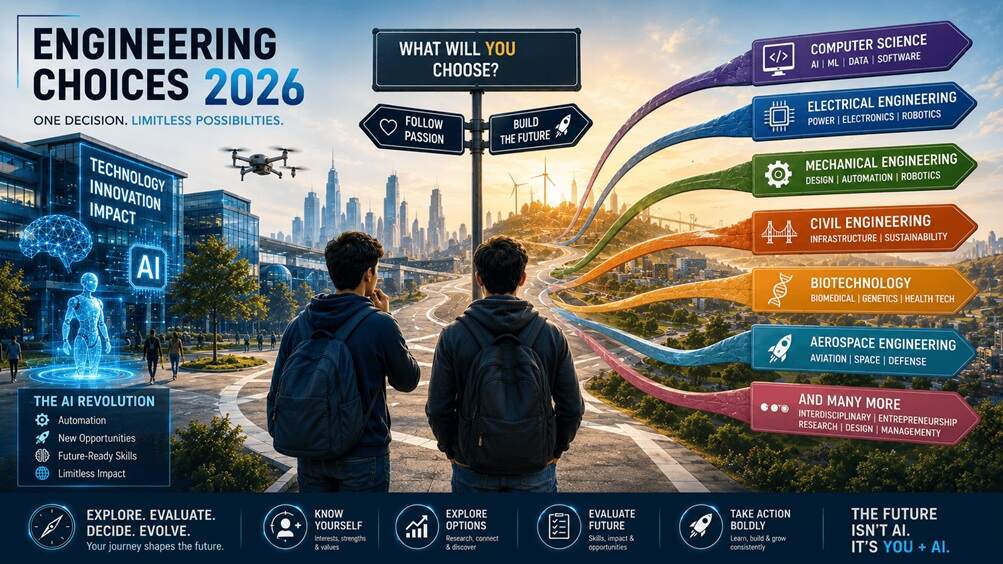
1. Introduction: The "After-JEE" Crisis
Congratulations to all students who have cleared one of the most gruelling examinations in the world. This achievement reflects not only your hard work but also your resilience. Yet, as you now look at your rank and the JoSAA preference list, the initial joy may be giving way to quiet anxiety. The engineering landscape of 2026 onwards is unlike what your seniors faced just a few years ago—headlines speak of AI-driven layoffs and shrinking junior roles, even as technology races ahead at breakneck speed. The familiar rules of 2022 no longer apply. You are stepping into a paradox: opportunities are vast, but the pathways are shifting.
This guide has been crafted to help you make informed choices—balancing college brand and branch selection—by drawing on the latest AICTE curriculum reforms, industry labour data, and the evolving “Brand vs. Branch” equation. Think of it not just as advice for 2026, but as a roadmap for the decade ahead.
2. Takeaway 1: The "CS or Nothing" Era is Over
For a decade, Computer Science was the only perceived path to a stable future. However, the AICTE 2026 curriculum overhaul has democratized high-end tech skills across all engineering disciplines. AI and Machine Learning are now mandatory components for Mechanical, Civil, Biotech, and even Textile Engineering. The new model shifts away from rote theory, moving practical exposure from a mere 25% to a range of 40–75%. To support this, the IndiaAI Compute Portal now provides students, even in tier-2 and tier-3 colleges, access to world-class GPU power (NVIDIA H100s and AMD MI300Xs) for as low as ₹67 per hour.
Old Curriculum vs. New 2026 Curriculum
| Aspect | Old Curriculum | New 2026 Curriculum |
|---|---|---|
| AI Coverage | CS/IT branches only | Mandatory for all branches |
| Practical Exposure | 25–30% of coursework | 40–75% of coursework |
| AI Introduction | 3rd or 4th Semester | 1st Semester onwards |
| Teaching Model | Theory-first, lecture-heavy | Industry-led, project-based |
| Compute Access | Limited to top institutes | National GPU Portal (subsidized) |
3. Takeaway 2: The "Safe" Branch Myth and the Junior Role Contraction
The era of a "safe" branch is dead. Data from late 2025 shows a 13% relative decline in employment for early-career workers (ages 22–25) in AI-exposed fields. This is the "Junior Job Squeeze." Tools like Cursor (an AI-powered coding assistant) and autonomous AI agents are now performing the testing and boilerplate coding that used to be the entry point for freshers. One senior engineer with an AI agent is now 5–10x more productive than a team of juniors. In a striking example, a feature that previously required 10 junior engineers to handle 40 small tasks can now be managed by a single experienced dev utilizing AI agents. This shift was underscored by the March 31, 2026, Oracle layoffs, which affected 10,000–12,000 employees in India alone—including top-tier graduates. Note on Market Reality: A 24-year-old IIT Roorkee graduate, was laid off from Oracle's Bengaluru office despite having three years of experience and being the sole developer on a critical feature. In the same wave, a software engineer with eight months of experience, was let go before his ESOPs could even vest.
The most resilient specializations for 2026 onwards:
CSE with AI/ML Focus: Essential for building the tools, not just using them.
ECE with Semiconductor/SoC Focus: Shielded by India’s Semiconductor Mission.
Automation-Focused Mechanical: Crucial for the intersection of robotics and smart manufacturing.
4. Takeaway 3: Brand vs. Branch—The Old IIT Premium in a Tight Market
The Classic Dilemma: Old IIT Lower Branch vs. Top NIT CSE
Navigating the choice between a lower or core branch at a legacy IIT (Bombay, Delhi, Madras, Kanpur, or Kharagpur) and a Computer Science Engineering (CSE) seat at a top-tier to decent NIT (Trichy, Surathkal, Warangal, etc.) is often the biggest hurdle for high rankers. Here is an objective, point-wise breakdown to help you decide:
-
The IIT "Brand Premium" as a Hedge In a volatile job market, the tag of an old IIT acts as a powerful safety net. The peer group, alumni network, and campus ecosystem provide a superior launchpad for students who might want to pivot their careers later, offering the flexibility to explore fields entirely unrelated to their enrolled branch.
-
Immediate Placements vs. Long-Term Ceiling
- Average Starting Package: Top NIT CSE programs (₹20–27 LPA) typically outperform Old IIT lower/core branches (₹12–18 LPA) in immediate domestic tech roles.
- Salary Ceiling (Highest Offers): Old IITs maintain a massive lead when it comes to the "ceiling" potential due to international tech offers, high-stakes quant/finance roles, and elite research positions.
-
The 5-Year Career Trajectory The IIT tag carries significantly more weight if your long-term goals lie outside of immediate software engineering:
- Higher Education (Global): An IIT Bombay Metallurgy graduate with solid research publications often has a substantially better chance of securing a fully-funded PhD admission at institutions like MIT or Stanford compared to an NIT CSE graduate.
- Management & Civil Services: For those targeting top IIMs (Ahmedabad, Bangalore, Calcutta) or the UPSC exams, the old IIT brand value provides a distinct edge in profile shortlisting and interviews.
- Entrepreneurship: The incubator support, networking events, and venture capital access at legacy IITs are unmatched in the country.
5. Takeaway 4: Hardware is the New Software (The Semiconductor Push)
As software tasks become increasingly automated, the real strategic frontier is shifting to the hardware that powers AI. Backed by the National Quantum Mission and India’s Semiconductor Mission, Electronics and Communication Engineering (ECE) is regaining its reputation as a “sunshine” branch.
Specializations such as VLSI Design, System‑on‑Chip (SoC) Architecture, and Nanoelectronics are seeing strong demand. AI’s dependence on specialized chips means that those who can bridge the hardware–software gap are now among the most sought‑after professionals.
Key Hardware–Software Hybrid Roles
- Embedded AI Engineer
- Chip Design Engineer (VLSI/SoC)
- IoT Systems Developer
- Robotics Hardware Specialist
- National Quantum Mission Researcher
Expanding Beyond ECE
It’s not just ECE. Other core branches are also evolving with industry demand:
- Electrical Engineering: Smart grid engineer, power electronics designer, renewable energy systems specialist.
- Mechanical Engineering: Robotics design engineer, automation systems developer, additive manufacturing (3D printing) specialist.
- Civil Engineering: Smart infrastructure engineer, sustainable materials researcher, digital twin modeling expert.
- Biotech & Chemical Engineering: Bio‑informatics engineer, process automation specialist, nanomaterials developer.
For students, the message is clear: don’t see hardware as “old school.” In the AI era, hardware is the backbone, and mastering your branch’s modern applications can make you more valuable than chasing generic software roles. The future belongs to those who can own their discipline and adapt it to the AI‑driven world.
6. Takeaway 5: The "Branch Change" Gamble is Getting Riskier
Many students take a lower branch at a top institute with the singular goal of "sliding" into CSE after the first year. This is a statistically dangerous bet. Top IITs (Bombay/Delhi/Madras): The success rate for a switch to CSE has tightened to a mere 0.5–1% of the cohort.
Mid-tier NITs: Success rates typically hover between 3–5%. Private Deemed Universities (BITS Pilani): Offers more flexibility at 5–15%.
The Hidden Costs of the Switch Strategy:
Portfolio Stagnation: To achieve the required 9.0+ CGPA, students often spend their first year in library isolation, skipping the very internships, hackathons, and foundational projects that build a resume.
Burnout Risk: If you fail the switch, you are left in a branch you may dislike, with no project work and a high risk of academic burnout by your second year.
The Shift Nobody Is Talking About
For years, students from every branch—Mechanical, Electrical, Civil—saw software jobs as a dependable fallback, not just Computer Science majors. But the layoffs of 2025–26 have shattered that myth. The reality is clear: software is no longer the universal safety net it once seemed.
With the new AICTE curriculum, core branches are now far more industry‑aligned. This means that a student who masters their own discipline—whether it’s Mechanical, Electrical, or Civil—can often hold greater value than a CS generalist.
The lesson is simple: instead of chasing a risky branch change, it’s wiser to own your branch and build depth in it. In today’s landscape, genuine expertise in your chosen field will stand out more than a forced switch into Computer Science.
7. Takeaway 6: BS vs. BTech—Placement Parity for High-Stakes Roles
For many aspirants, the difference between a BS (Bachelor of Science) and a BTech (Bachelor of Technology) degree at IITs sparks anxiety, especially when thinking about placements. The truth is that in certain high‑stakes domains—such as High-Frequency Trading (HFT) and Quantitative Research (QR)—the label on your degree matters far less than the skills you bring to the table.
Top recruiters like Jane Street, Tower Research, and Graviton consistently prioritize candidates with strong mathematical and computational foundations. In fact, a BS in Mathematics or Scientific Computing from a leading IIT is often viewed as equivalent, and sometimes even superior, to a general BTech in Computer Science when it comes to quant roles. The reason is simple: algorithmic trading demands deep expertise in probability, statistics, and advanced mathematics—areas where BS programs excel.
For students aiming at the ₹50 LPA+ quant market, the distinction between BS and BTech fades into irrelevance. What matters most is your ability to solve complex problems, demonstrate mathematical rigor, and perform under pressure in competitive hiring processes.
That said, it’s important to note the trade‑offs: while BTech CSE offers broader career flexibility across software, consulting, and product roles, the BS track is more specialized, aligning strongly with research, academia, and quant finance. Choosing between them should depend on whether you want breadth of opportunities or depth in mathematics‑driven careers.
8. Takeaway 7: The Rise of the "Flexible Degree" (NEP 2020)
The rigid “four-year lock-in” of engineering is giving way to a more humane and adaptable model. Under the National Education Policy (NEP 2020), the new curriculum now allows multiple entry and exit points backed by the Academic Bank of Credits (ABC). This means your education can flex with your life circumstances:
- Year 1 Exit: Certificate in foundational subjects (e.g., AI Fundamentals).
- Year 2 Exit: Diploma with specialization (e.g., AI or core engineering).
- Year 3/4 Completion: Full BTech or BS degree, with the option of an Honours track if research is added.
Why this matters for students
- Safety net in uncertainty: If family, financial, or startup opportunities demand a break, you can pause without losing all progress.
- Return anytime: Credits are stored digitally in the Academic Bank, so you can resume later at the same or another institution.
- Value of mastery: Each exit point gives you a recognized qualification, not just a "dropout" status.
Think of this as education designed to support your journey, not trap you. Instead of fearing “what if I can’t finish,” you now have structured milestones that carry value at every stage. In an era of economic volatility, this flexibility ensures your degree is a lifelong asset rather than a four-year prison.
Conclusion:
Software engineering will continue to thrive, but the routine way of coding is already being reshaped by automation and AI. As you prepare to lock in your JoSAA choices, pause for a moment and ask yourself: Are you choosing a branch because of yesterday’s placement hype, or because of tomorrow’s opportunities in an AI‑driven world?
The Final Word:
An institution’s legacy—like the IIT brand—gives you a powerful network, resources, and credibility to weather market shifts. But in a world where technology evolves overnight, your true safety net is your adaptability. The college provides the platform, but the effort, skill‑building, and resilience must come from you.
The Golden Rule for JoSAA: Select a branch that equips you to create and innovate, and a college that empowers you to pivot when the landscape changes. Think not just of the next four years, but of the decade ahead—because the choices you make today will shape the opportunities you can seize in 2030.
Start Your Preparation in a Structured Way
Create a free account on Vidyaaytan Prep to access interactive study, mock tests, PYQs, analytics, and focused preparation tools.
Discussion
No comments yet. Be the first to start the discussion!